

Customs Today
  • Home
  • Islamabad
  • Karachi
  • Lahore
  • National
  • Transfers and Postings
  • Chambers & Associations
  • Business
No Result
View All Result
Customs Today
  • Home
  • Islamabad
  • Karachi
  • Lahore
  • National
  • Transfers and Postings
  • Chambers & Associations
  • Business
No Result
View All Result
Customs Today
No Result
View All Result
Home Science & Technology Science

Black hole wake up in a dramatic display after millions of years

byCustoms Today Report
11/07/2015
in Science, Science & Technology
Share on FacebookShare on Twitter

You might also like

Tesla driverless system to use updated radar technology

12/09/2016

Apple to develop its own self-driving technology

10/09/2016

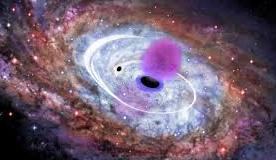
CANADA: 42 million light years away, 20 million times the mass of the Sun, and coming back to life. A team of radio astronomers, led by Dr Megan Argo of the Jodrell Bank Centre for Astrophysics, are watching a previously dormant black hole wake up in a dramatic display as material falls on to it for the first time for perhaps millions of years. Dr Argo reported their work today (9 July) at the National Astronomy Meeting at Venue Cymru, in Llandudno, Wales.
Almost every galaxy, including our own, appears to have a black hole at its core. Most of the time these are quiet, with just their invisible gravitational pull shaping their surroundings. But in about 10% of galaxies the central black hole is much more active, swallowing material and spitting out giant jets. For the first time, the new study shows convincing evidence of the onset, the ‘switching on’ of this active phase, in a black hole at the centre of the galaxy NGC 660, 42 million light years away in the constellation of Pisces.
NGC 660 is a stunning example of a polar ring system galaxy. Like most galaxies, it has a thick disk of stars and gas. But NGC 660 also hosts a larger and much less dense ring of stars and smaller star-forming clouds, in orbit over its poles. This additional ring is thought to be the remnants of a past encounter with another galaxy that disrupted both systems.

Related Stories

Tesla driverless system to use updated radar technology

byCT Report
12/09/2016

WASHINGTON: Electric carmaker Tesla announced Sunday it was upgrading its Autopilot software to use more advanced radar technology. In a...

Apple to develop its own self-driving technology

byCT Report
10/09/2016

SAN FRANCISCO: Apple may not become an automaker, but it still wants to develop its own self-driving technology. The iPhone-maker's...

NASA spots slowest known magnetar

byCT Report
10/09/2016

WASHINGTON: Astronomers have found evidence of a magnetar - magnetised neutron star - that spins much slower than the slowest...

‘YouTubers’ outshining old-school television

byCT Report
09/08/2016

SAN FRANCISCO: A media revolution is taking place, and most people over 35 years of age aren’t tuned in. Millennial...

Next Post

Climate change reportedly threatens for bumblebees survival

  • Terms and Conditions
  • Disclaimer

© 2011 Customs Today -World's first newspaper on customs. Customs Today.

No Result
View All Result
  • Transfers and Postings
  • Latest News
  • Karachi
  • Islamabad
  • Lahore
  • National
  • Chambers & Associations
  • Business
  • About Us

© 2011 Customs Today -World's first newspaper on customs. Customs Today.