
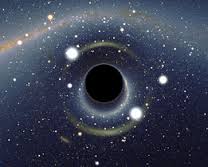


PARIS: A new study has found that black holes are not the dangerous zones that most people and experts believe them to be. The nasty reputation of these cosmic materials are mathematically refuted by a group of scientists in a recent research
The study, led by Samir Mathur from Ohio State University, suggests that the firewall theory made by scientists in the past is not wholly accurate. In the firewall theory, experts believe that black holes are enveloped in a coating of some sort, which may shatter everything that gets in contact with it.
In contrast, Mathur’s fuzzball or string theory proposes that black holes are perplexed balls of cosmic strings.
Mathur’s team further studied the fuzzball theory separately from the scientists behind the firewall theory, but came up with completely different findings. In a study published online in arXiv, Mathur and his colleagues suggest that black holes do not cause harm to anything that touches it; instead, they act as harmless copier machines that create a hologram. The hologram is a close-to-perfect duplicate of itself that thrives as it did before the contact.
The idea of a near-perfect possibility has been the main point of debate among physicists since the new study was released. This is because of a hypothesis made in the area of physics by Leonard Susskind of Stanford University in 1993. The hypothesis is called complementarity, which necessitates any hologram made by the black hole to be a flawless copy of the authentic version.
Physicists from either side of the firewall and fuzzball theories, although different in views, agreed that absolute complementarity is impossible and thus a perfect hologram cannot be generated opposite a black hole. Mathur and his colleagues refute this by saying that a modified type of complementarity exists and they have mathematical evidence to prove it.

Karachi Port sets 138-year cargo handling record
KARACHI: Pakistan's maritime sector has achieved a major milestone as Karachi Port set a new record in its 138-year history...


