Customs Today
  • Home
  • Islamabad
  • Karachi
  • Lahore
  • National
  • Transfers and Postings
  • Chambers & Associations
  • Business
No Result
View All Result
Customs Today
  • Home
  • Islamabad
  • Karachi
  • Lahore
  • National
  • Transfers and Postings
  • Chambers & Associations
  • Business
No Result
View All Result
Customs Today
No Result
View All Result
Home Science & Technology Science

Black holes brightest objects in the universe

byCustoms Today Report
06/11/2015
in Science, Science & Technology
Share on FacebookShare on Twitter

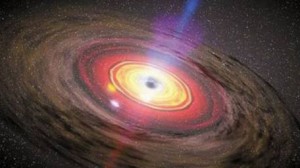
BRENT: Black holes are paradoxically some of the brightest objects in the universe. It’s not the black holes themselves that are bright; it’s their entourages. Surrounding these spacetime warps are glowing disks of hot gas, which can feed blazing jets and flares.Astronomers regularly watch black holes flare, but they’re not actually sure why flares happen. New X-ray observations suggest that these brilliant surges are a sort of physics-engendered optical effect, created by changes in a mysterious structure called the corona.

The corona is a haze of high-energy electrons that hovers over the black hole and its accretion disk. The electrons whiz around with so much energy that when they collide with ultraviolet photons flying away from the disk, they give a mighty kick that turns those photons into X-rays. These X-rays in turn reflect back off the accretion disk, carrying away spectral fingerprints from the disk that reveal things like how fast the black hole is spinning.


You might also like

Tesla driverless system to use updated radar technology

12/09/2016

Apple to develop its own self-driving technology

10/09/2016

Although astronomers know the corona is there, they don’t know exactly what it looks like — it might be a compact “light bulb” shining on the disk, an extended cloud, or, to steal a metaphor from JPL’s press release, the sandwich bread on either side of the disk’s ham.

Dan Wilkins (Saint Mary’s University, Canada) and colleagues explored what makes a flare happen by observing the active black hole at the center of the galaxy Markarian 335, which lies roughly 350 million light-years away in the constellation Pegasus. Mrk 335 is well known for its fits of brilliance, its X-ray emission rising and falling at whim. Previous observations have hinted that these changes come with changes in the corona’s structure.


 

Related Stories

Tesla driverless system to use updated radar technology

byCT Report
12/09/2016

WASHINGTON: Electric carmaker Tesla announced Sunday it was upgrading its Autopilot software to use more advanced radar technology. In a...

Apple to develop its own self-driving technology

byCT Report
10/09/2016

SAN FRANCISCO: Apple may not become an automaker, but it still wants to develop its own self-driving technology. The iPhone-maker's...

NASA spots slowest known magnetar

byCT Report
10/09/2016

WASHINGTON: Astronomers have found evidence of a magnetar - magnetised neutron star - that spins much slower than the slowest...

‘YouTubers’ outshining old-school television

byCT Report
09/08/2016

SAN FRANCISCO: A media revolution is taking place, and most people over 35 years of age aren’t tuned in. Millennial...

Next Post

South korean stocks jump in early trade, KOSPI adds 2.45pts

  • Terms and Conditions
  • Disclaimer

© 2011 Customs Today -World's first newspaper on customs. Customs Today.

No Result
View All Result
  • Transfers and Postings
  • Latest News
  • Karachi
  • Islamabad
  • Lahore
  • National
  • Chambers & Associations
  • Business
  • About Us

© 2011 Customs Today -World's first newspaper on customs. Customs Today.