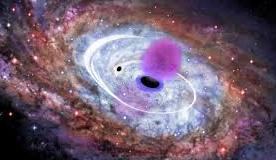
HONG KONG: Black holes can be found at the centres of most galaxies. Most have little mass compared with their host galaxy. ETH researchers, however, have discovered a particularly massive black hole, which clearly grew so quickly that the host galaxy was not able to keep pace. This calls into question previous thinking on the co-evolution of galaxies and their central black holes.
Benny Trakhtenbrot, a researcher at ETH Zurich’s Institute for Astronomy, together with an international team of astrophysicists, was hunting for ancient massive black holes using the 10 meter Keck telescope in Hawaii. Although this kind of observations are routine for them, Trakhtenbrot and the team were surprised by the first black hole they looked at. The data, collected with a new instrument, revealed a giant black hole in an otherwise normal, distant galaxy, called CID-947. Because its light had to travel a very long distance, the scientists were observing it at a period when the universe was less than two billion years old, just 14 percent of its current age (almost 14 billion years have passed since the Big Bang).
An analysis of the data collected in Hawaii revealed that the black hole in CID-947, with nearly 7 billion solar masses, is among the most massive black holes discovered up to now. What surprised researchers in particular was not the black hole’s record mass, but rather the galaxy’s mass. “The measurements correspond to the mass of a typical galaxy,” says Trakhtenbrot, a postdoctoral fellow working within the Extragalactic Astrophysics research group of Professor Macella Carollo. “We therefore have a gigantic black hole within a normal size galaxy.” The result was so surprising, that two of the astronomers had to verify the galaxy mass independently. Both came to the same conclusion. The team reports its findings in the current issue of the scientific journal Science.