Customs Today
  • Home
  • Islamabad
  • Karachi
  • Lahore
  • National
  • Transfers and Postings
  • Chambers & Associations
  • Business
No Result
View All Result
Customs Today
  • Home
  • Islamabad
  • Karachi
  • Lahore
  • National
  • Transfers and Postings
  • Chambers & Associations
  • Business
No Result
View All Result
Customs Today
No Result
View All Result
Home Uncategorized

Brain circuit in fruit fly

byCustoms Today Report
08/07/2015
in Uncategorized
Share on FacebookShare on Twitter

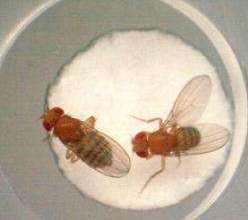
CANADA: New research, published today in eLife, identified the neural circuit in the brain of the fruitfly (Drosophila melanogaster) that is responsible for detecting a taste pheromone, which controls the decision of male flies to mate with females.
In the natural world, sense of taste controls many behavioral decisions. For many animals, pheromones, which are chemical signals used for communication, influence the choice to mate. However, very little is known about how taste pheromones are processed in the brain.

The recent work by Joanne Yew, assistant researcher at the Pacific Biosciences Research Center (PBRC), a newly integrated research unit of the School of Ocean and Earth Science and Technology (SOEST) at the University of Hawai’i – Mānoa, and colleagues explicitly tracked this process – identifying the taste cells on the fruitfly’s legs which detect the pheromone, locating the neurons in the brain which respond to the pheromone, and mapping the connection between the two populations of cells.

You might also like

Pakistan to get $3b loan from Islamic Trade Financing Corporation

20/10/2024

Lahore I&I & Enforcement anti-smuggling operations achieve record success in early FY 2024-25

10/09/2024

The pheromone, named CH503, is produced by males, passed to females during mating, and stops other males from mating with the female – it is an anti-aphrodisiac for other males.

Many taste cells are found on the forelegs of flies, so Yew and colleagues used genetic manipulation to turn off activity in individual classes of these taste cells. They then tested whether males could still respond to the pheromone. Using this strategy, they were able to identify one class of taste receptors, called Gr68a, that is responsible for detecting the pheromone.


Related Stories

Pakistan to get $3b loan from Islamic Trade Financing Corporation

byCT Report
20/10/2024

ISLAMABAD: Islamic Trade Financing Corporation (ITFC) to provide Pakistan with a $3 billion loan, according to an official statement released...

Lahore I&I & Enforcement anti-smuggling operations achieve record success in early FY 2024-25

byCT Report
10/09/2024

LAHORE:  Regional Directorate of Customs Intelligence & Investigation has demonstrated exceptional performance in the first two months of the fiscal...

ICCI and CDA to join hands for tree plantation drive in Capital

byQaisar Mansoor
09/08/2023

ISLAMABAD: Islamabad Chamber of Commerce and Industry (ICCI) in collaboration with the Capital Development Authority (CDA) would jointly launch a...

Customs Officials Yawar Abbas & Tariq Mehmood kidnapped in Karachi

byCT Report
08/07/2023

KARACHI: Customs Intelligence Officer Yawar Abbas and Customs Preventive Officer Tariq Mehmood who were working against smuggling were kidnapped by...

Next Post

Bandai Namco hosts "King of Iron Fist 2015" Tekken 7 tournament to celebrate 20th anniversary

  • Terms and Conditions
  • Disclaimer

© 2011 Customs Today -World's first newspaper on customs. Customs Today.

No Result
View All Result
  • Transfers and Postings
  • Latest News
  • Karachi
  • Islamabad
  • Lahore
  • National
  • Chambers & Associations
  • Business
  • About Us

© 2011 Customs Today -World's first newspaper on customs. Customs Today.