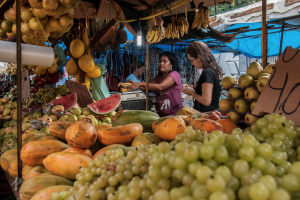
RIO DE JANEIRO: According to a study released, the informal market in Brazil was worth R$826 billion in 2014, equivalent to 16.1 percent of the country’s gross domestic product (GDP). The informal economy was measured in the Shadow Economy Index (HEI) by the Brazilian Institute for Ethical Competition (ETCO) and the Brazilian Institute of Economics of the Fundação Getulio Vargas (IBRE-FGV.
This represents a remarkable change from 2008, when the FGV reported the cost of goods and services produced by Brazil’s underground economy amounting to the equivalent of 27.1 percent of the 2007 GDP. At the time the report said that “excessive bureaucracy and corruption” and a drop in exports as a percentage of GDP contributed to the growth of the underground economy.


With this most recent report by IBRE-FGV, considering the share of the informal market in relation to GDP, the 2014 result is down 0.2 percent compared to the previous year. The annual reductions in this decade were 0.5 percent in 2013, 0.2 percent in 2012, 0.8 percent in 2011 and 0.8 percent in 2010.
However, “The measures taken by the government to combat informality – as the exemption of certain sectors of the economy and policies aimed at small business owners – although effective, are not enough to curb informality in this scenario,” said the FGV, in a statement.
In 2009, the government launched a new program to help irregular workers and micro-entrepreneurs register and legalize their business entity with a thirty-minute visit to their website. The effort opened access to the Simples Nacional program, a taxation system for small business that merges several taxes into one payment, and lessens the tax burden overall.
The benefits offered by the government in return are; access to banking facilities, which entitles the legalized entity to apply for credit at market interest rates, as well as assistance in health care coverage, death and maternity for the worker/business person and their family, and even retirement assistance.
According to yesterday’s FGV research report, in order to further combat informality in the economy, there needs to be greater rationalization of the tax system, modernization of the billing system, an increase in the educational level of the population and reduction of unemployment.
A 2006 report by the The World Bank Development Research Group, found “a clear negative trend in the size of the shadow economy: The unweighted average of the 162 countries in 1999 was 34.0 percent and in 2007 31.0 percent.” The report listed Brazil 55th best in developing countries with a shadow economy of 38.9 percent of the GDP, and Bolivia as the worst with 66.9 percent of the economy being unreported. China ranked best with only 12.8 percent of the GDP.