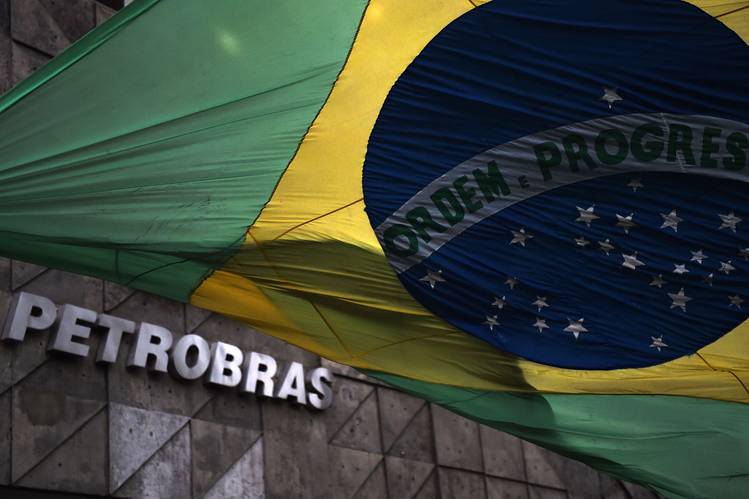
RIO DE JANEIRO: Brazilian state-run oil company Petró leo Brasileiro SA said it plans to slash investments by 37% over the next five years in what analysts see as an urgent effort to reduce debt and recover investor confidence amid a corruption scandal.
Petrobras expects capital spending over the 2015-19 period to total $130.3 billion, the company said in a long-delayed document outlining its five-year business plan. Petrobras’s previous five-year plan, through 2018, listed $206.8 billion in projects under way.


“All the majors are [cutting] because oil prices are down,” Brazilian Finance Minster Joaquim Levy told The Wall Street Journal in New York. “That’s how it should be done. The price is down, you factor that into your core business.”
The cutback has huge implications Brazil’s economy, which is already forecast to contract by more than 1% this year. Petrobras is the nation’s single biggest source of investment, supporting a massive network of suppliers and construction activity. Its sales in 2014 were equivalent to around 6% of Brazil’s GDP, while its capital expenditures accounted for nearly 8% of total investment.
“Investment is what Brazil needs in order to get the economy growing again,” says Neil Shearing, chief emerging- markets economist at London-based Capital Economics. “When the largest company in the country is cutting back investment, that’s going to be quite difficult to achieve.”
The revised plan also deals a significant setback to Brazil’s ambitions of joining the world’s top five oil-producing nations by the end of this decade. Petrobras reduced its 2020 domestic production target to 2.8 million barrels of oil equivalent a day, down from a previous goal of 4.2 million barrels.
“All these years, and especially after the ‘pre-salt’ [oil reserves] announcement, Brazil experienced a situation of great euphoria and megalomania,” said Adriano Pires, president of the Brazilian Infrastructure Center, a consultancy. ” Now the country is being forced to face reality.”
The new numbers represent a drastic change of course for Petrobras.
For the past decade, the company has been at the center of an ambitious state industrial policy mapped out by the left-leaning governments of President Dilma Rousseff and her predecessor, Luiz Iná cio Lula da Silva. Emboldened by major discoveries off Brazil’s coast, the two presidents attempted to use the oil industry as a vehicle for broader economic development in Brazil.
The result was a spending spree that left Petrobras with the highest debt load of any oil major. Capital expenditures rose thirteenfold between 2000 and 2013. The company threw unprecedented resources into extracting oil from technically challenging deposits several kilometers beneath the sea floor. It also launched several huge refineries that ran billions of dollars over budget.
Experts say those efforts stretched the company’s focus—and its resources — too thin. Strict government mandates required Petrobras to be the lead operator and hold a minimum 30% stake in newly discovered “pre-salt” oil fields. High local-content rules led to cost overruns and production delays. All the while, the company continued paying hefty dividends to investors, while the government forced Petrobras to subsidize domestic fuel prices for ordinary Brazilians in order to keep a temporary lid on inflation.
Petrobras binged on foreign debt to finance the splurge, enabled by ultralow interest rates in the U.S. and Europe that sent investors scouring the globe for better returns. After holding steady around $21 billion between 2005 and 2007, the company’s total debt ballooned in the following years to an all-time high of $132 billion at the end of 2014.
The spending created an environment ripe for corruption. Brazil is now convulsed by a scandal that has rocked the highest levels of business and government. Brazilian prosecutors say a handful of crooked former Petrobras executives took bribes from construction companies that colluded to drive up prices for major contracts, funneling a portion of the ill-gotten gains to politicians and political parties. Petrobras, which considers itself a victim of the scheme and says it is working with authorities, wrote off more than $19 billion in 2014 due to corruption and overvalued assets.
But the company’s battle to regain lost credibility promises to be a tough one. The leaner investment plan had been the primary focus of Chief Executive Aldemir Bendine, who took Petrobras’s helm earlier this year amid a deep crisis at the company. He has also promised to strengthen corporate governance and reduce debt to more manageable levels.
In addition to lower capital expenditures, Petrobras ramped up plans to sell assets. The company now expects to divest $15.1 billion in 2015-16, up from a previous target of $13.7 billion. Petrobras’s new plan also “foresees business restructuring efforts, demobilization of assets and additional divestments” of $42.6 billion in 2017-18.
Rogé rio Freitas, a fund manager at Rio de Janeiro’s Teó rica Investimentos, said it isn’t clear which assets Petrobras will sell, and at what price. An explicit policy for domestic fuel prices—seen as a safeguard against government tinkering—was also absent, he said.
“The risk for the minority shareholder is a possible dilution by the government,” Mr. Freitas said. “They should have demonstrated that a capitalization by the government won’t be necessary in the future.”