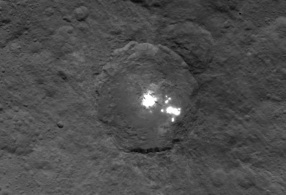


LONDON: The closer we get to Ceres, the more perplexing the dwarf planet grows. NASA’s Dawn spacecraft has found several more bright spots as well as a pyramid-like peak jutting out of the frigid world’s surface.
The discovery is painting an increasingly complex portrait of one of the biggest “fossils” from the early solar system.
“I expected to be surprised because we knew so little about Ceres,” Christopher Russell, Dawn’s principal investigator and a planetary scientist at the University of California, Los Angeles, said in an email. “I never expected bright spots and a pyramid to be the surprises.”
Ceres is one of five dwarf planets in the solar system and the largest member of the asteroid belt, the vast ring of rocky debris that stretches between the orbits of Mars and Jupiter.
Asteroids are the building blocks of planets that never came to be, and scientists hoped that by studying two of the largest protoplanets in the belt – first the lumpy asteroid Vesta, and now the dwarf planet Ceres – the Dawn mission could learn more about the early development of our solar system.
By the time the spacecraft arrived at Ceres in March, speculation had already grown about the nature of the dwarf planet’s surface. Many researchers had suspected that Ceres, which seemed to be rich in water ice, would have fairly smooth, young terrain.
Instead, as the spacecraft grew ever closer in the home stretch of its 7{-year journey, it began sending back images of a much rougher, cratered surface than expected. Even stranger: a mysterious bright spot (previously observed by NASA’s Hubble Space Telescope) that seemed to shine like a beacon from the surface.
That bright spot resolved into two bright spots as the spacecraft got closer, and new images show that the dimmer companion is actually not one, but at least eight smaller spots.

Karachi Port sets 138-year cargo handling record
KARACHI: Pakistan's maritime sector has achieved a major milestone as Karachi Port set a new record in its 138-year history...