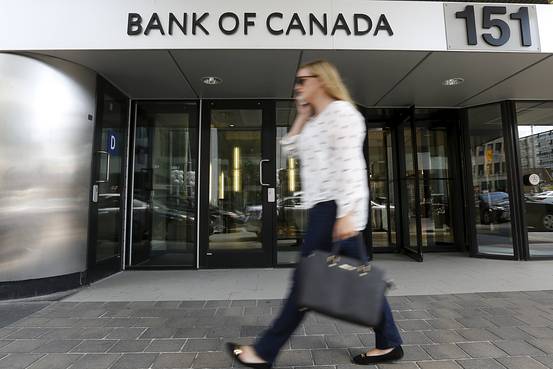


OTTAWA: The Canadian central bank is expected to hold its key interest rate steady at 0.5% this week amid growing signs the economy may be strengthening after two consecutive quarters of contraction.
All 11 primary dealers of Canadian government securities surveyed by The Wall Street Journal predicted the Bank of Canada will stand pat on Wednesday. Most cited recent economic data that pointed to a resilient labor market, improving export data and a return to economic growth during the month of June.
“Given the string of reports that we got this week, it’s an easier call to stay on hold, absolutely,” said Stéfane Marion, chief economist at National Bank of Canada.
A majority of the economists surveyed said they expected rates to remain unchanged at least until the end of 2015. But several said their forecast for the coming months could change if market volatility worsens or if the recent improvements in Canada’s economic data turn out to be short-lived.
Sharply lower oil prices have hurt the Canadian economy during the past year, driving down business investment and the value of the Canadian dollar. Statistics Canada reported last week that the Canadian economy shrank by 0.5% on an annualized basis in the April-to-June period, marking a second straight quarterly contraction.
More recently, there have been signs the Canadian economy may be improving: Gross domestic product ticked up in June, for the first time this year; and data released so far for July and August have been relatively strong.
“Even with all the market turmoil that we’ve seen and even with the setback in oil prices, fundamentally the economy is doing roughly what the Bank of Canada thought it would do,” said Doug Porter, chief economist at BMO Capital Markets.
Bank of Canada Gov. Stephen Poloz has cut rates twice so far this year. After a surprise decision to lower the key rate by a quarter percentage point in January, he cut again in July, citing persistently low oil prices and a slow recovery in nonenergy exports. The central bank chief has said he believes the low Canadian dollar and strengthening U.S. economy will boost Canadian exports, helping to drive growth on the nonresource side of the economy. A weak Canadian dollar tends to boost exports to the U.S., where about three-quarters of Canadian exports are sent.
The U.S. Federal Reserve is widely expected to raise rates in the near future, which should further reduce the value of the Canadian dollar. Several economists said that is another good reason for the Bank of Canada to hold off before changing the rate again.
Still, persistently low oil prices, along with turmoil in the global markets, have raised concerns among some economists about Canada’s ability to recover from the slowdown.
David Watt, economist at HSBC Bank Canada, said he doesn’t expect a change this week but has a rate cut penciled in for the end of October, based in large part on oil price trends and turbulence in global markets.
“Renewed pressure on the oil patch suggests the impact of oil has already been larger and more persistent and will continue to persist through the year-end with impacts on business investment,” he said.

NH&C Ministry, LCCI to jointly promote creative economy: Aurangzeb Khichi
LAHORE:Ministry for National Heritage & Culture (NH&C) and Lahore Chamber of Commerce and Industry (LCCI) will work together to promote...