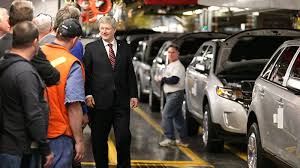

OTTAWA: Canadian Prime Minister Stephen Harper on Tuesday said his government would invest 1 billion Canadian dollars (about $764 million) in the country’s auto industry over a decade, moving to address worries about the impact a landmark Pacific trade deal could have on the sector.
The Trans-Pacific Partnership, struck Monday, would give Canadian exporters greater access to several fast-growing Pacific-rim economies for products including machinery, beef and pork, grains and forest products, Mr. Harper said on Monday, calling the trade agreement with 11 other Pacific countries, including the U.S. and Japan, a boon to job creation.
While Canada’s business community has largely praised the deal, auto-parts makers and labor groups have said the deal would have a negative impact on their industry. Under the deal, Canada agreed to phase out its 6.1% tariff on imports of Japanese-made cars and parts over five years. The deal also sets the bar for TPP-based components in cars at 45%, less than the Canadian car industry sought and below the 60% threshold under the North American Free Trade Agreement.
“We will do whatever it takes to ensure” the auto industry’s growth in Canada, said Mr. Harper in announcing the funding. Mr. Harper, who is seeking a fourth mandate from Canadian voters in a national election set for Oct. 19, on Tuesday defended Canada’s participation in the TPP. “If we are not part of the trade network that our partners in U.S. and Mexico are, we would simply long-term be putting ourselves outside of business opportunities,” he said.
Besides the auto sector, Mr. Harper also set aside C$4.3 billion for the country’s dairy farmers, after Ottawa agreed to make 3.25% of the highly protected domestic dairy market open to trade partners.
An official with the Toronto-based Canadian Vehicle Manufacturers Association said it needed to further review what Mr. Harper proposed, although he said the group was “encouraged” by some details made public.
Ratification in Canada of the TPP, and the pledges Mr. Harper has made to industry sectors, are contingent on his Conservative Party gaining a majority of seats in Canada’s parliament in the Oct. 19 vote.
Unifor, the union that represents 40,000 auto workers in Canada, warned the TPP deal could lead to job losses of up to 20,000. In a statement, Unifor President Jerry Dias said Mr. Harper’s pledge is an “acknowledgement that the TPP poses a significant threat to Canada’s auto industry.”
The auto industry recently overtook the energy sector as the largest source of Canadian exports amid the collapse in oil prices. Trade data for August released Tuesday indicated auto exports advanced 27.8% on a 12-month basis, while sales abroad of energy products plunged 40.2%.

Pakistan’s two and three-wheeler sales hit record 202,502 units in September
ISLAMABAD: Pakistan’s two- and three-wheeler sales reached an all-time high of 202,502 units in September 2026, crossing the 200,000-unit mark...