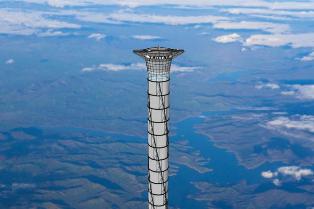


LONDON: A Canadian company has been granted a patent for their space elevator design – but is the enormous tower even feasible outside of science fiction?
It’s an idea that has captivated scientists and writers for over a century – maybe back to Babylon, if are so inclined: building a tower whereby we climb to space. In the late 1800s, it was the Russian father of rocketry, Tsiolkovsky, who first proposed a free-standing tower reaching from the surface of the Earth to the edge of space. Firing a rocket from Earth, the theories went, is nearly impossible – but once we get something into geostationary orbit, the rest is (relatively) a cake walk.
As it happens, we can successfully fire rockets from the Earth – but that’s not to say it’s always easy. A space elevator – a massively tall tower that reaches up past the atmosphere, carrying equipment and people close to orbit – could solve a lot of problems. If only someone would build one of these things!
It looks like Ontario, Canada-based company Thoth is going to try their hand at it. They were recently awarded a U.S. patent for their space elevator concept, and the scientific community is at once hopeful and sceptical.
Dr. Brendan Quine, the inventor, describes it thus: “Astronauts would ascend to 20 km by electrical elevator. From the top of the tower, space planes will launch in a single stage to orbit, returning to the top of the tower for refueling and reflight.”
Once the 20 km (a little over 12 miles), inflatable structure is built, an estimated 30% could be saved from fuel costs alone compared to conventional rockets.

Karachi Port sets 138-year cargo handling record
KARACHI: Pakistan's maritime sector has achieved a major milestone as Karachi Port set a new record in its 138-year history...