
PALM SPRINGS: Labor issues contributed to West Coast port congestion this past year, but it is the cargo surges from big ships and the “extraordinary randomness” of container discharges and truck visits to marine terminals that will be the longer-lasting problems for ports, according to Long Beach CEO Jon Slangerup.
Furthermore, cargo surges and random discharges of containers will only make it more difficult for West Coast ports to get their hands around the problem when ships with capacities of 18,000 20-foot-equivalent units begin calling in Southern California within two years, Slangerup told the annual Western Cargo Conference of freight forwarders and customs brokers Saturday in Palm Springs, California.
While not discounting the impact of the International Longshore and Warehouse Union work slowdowns and retaliation by the Pacific Maritime Association this past year, Slangerup said the port congestion and cargo diversion that plagued West Coast ports from November 2014 to May 2015 are now in the rearview mirror. Using the second-largest U.S. container port as an example, he noted that container volumes in Long Beach increased 14.8 percent year-over-year in the third quarter. “We have recovered very well, and rapidly,” he said.
Long Beach is now handling volumes comparable to what it handled in the peak years of 2006-07 without experiencing congestion, and most of the cargo that was diverted during the labor problems has returned. Long Beach’s volumes are up even more than anticipated because some carrier-alliance visits have been routed there from Los Angeles. When the volumes of both ports are combined, the largest U.S. port complex year-to-date through September handled 11,475,563 TEUs, up 0.7 percent from the same period last year, according to statistics published on the ports’ websites.
With the likelihood of continued growth in container volume, and the arrival of ever-larger ships, each one carrying the containers of five or more lines, ports must change how they process cargo, Slangerup said. Long Beach in recent years has been accommodating ships that are too large to transit even the enlarged Panama Canal when it opens next year. In fact, 56 percent of the ships on order today will be unable to transit the enlarged canal, he said.
Three of the carriers that call regularly in Long Beach have vessels of 21,000-TEU capacity or greater on order. As ships of that size enter the Asia-Europe service, slightly smaller vessels of 14,000- to 18,000-TEU capacity will cascade to the U.S. trades. Ports and terminals must work with the carriers to develop better stowage plans in Asia so that vessel unloading and the delivering of containers to trucks occurs in a more logical sequence at West Coast ports. “We have to get our arms around this,” said Slangerup, who was leaving that night for Japan to discuss container stowage and other issues with port clients.
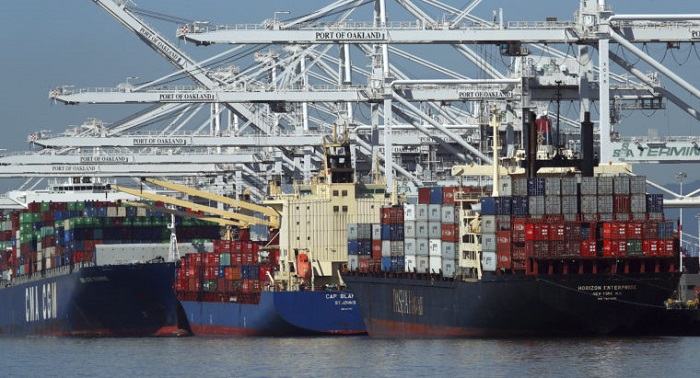
Shipping activity at Port Qasim on February 11
KARACHI: Three ships namely, Glen Canyon, Al-Salam- II and TSM Pollux carrying Containers, Gas oil and Palm oil were arranged...