MEXICO: Ceres reveals some of its well-kept secrets in two new studies in the journal Nature, thanks to data from NASA’s Dawn spacecraft. They include highly anticipated insights about mysterious bright features found all over the dwarf planet’s surface.
In one study, scientists identify this bright material as a kind of salt. The second study suggests the detection of ammonia-rich clays, raising questions about how Ceres formed.
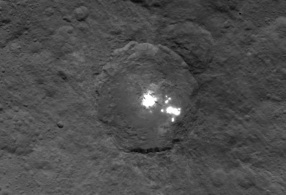
Ceres has more than 130 bright areas, and most of them are associated with impact craters. Study authors, led by Andreas Nathues at Max Planck Institute for Solar System Research, Göttingen, Germany, write that the bright material is consistent with a type of magnesium sulfate called hexahydrite. A different type of magnesium sulfate is familiar on Earth as Epsom salt.


Nathues and colleagues, using images from Dawn’s framing camera, suggest that these salt-rich areas were left behind when water-ice sublimated in the past. Impacts from asteroids would have unearthed the mixture of ice and salt, they say.
“The global nature of Ceres’ bright spots suggests that this world has a subsurface layer that contains briny water-ice,” Nathues said.
The surface of Ceres, whose average diameter is 584 miles (940 kilometers), is generally dark—similar in brightness to fresh asphalt—study authors wrote. The bright patches that pepper the surface represent a large range of brightness, with the brightest areas reflecting about 50 percent of sunlight shining on the area. But there has not been unambiguous detection of water ice on Ceres; higher-resolution data are needed to settle this question.
The inner portion of a crater called Occator contains the brightest material on Ceres. Occator itself is 60 miles (90 kilometers) in diameter, and its central pit, covered by this bright material, measures about 6 miles (10 kilometers) wide and 0.3 miles (0.5 kilometers) deep. Dark streaks, possibly fractures, traverse the pit. Remnants of a central peak, which was up to 0.3 miles (0.5 kilometers) high, can also be seen.