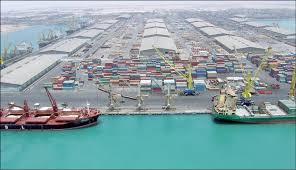
KARACHI: Afghanistan has shifted 80% of its cargo traffic from Pakistan’s Karachi seaport to Iran’s Bandar Abbas and Chabahar ports. The move comes two months after Chabahar, barely 100 kilometers from Pakistan’s Gwadar port, was inaugurated. The shift, prompted in part by a new trade tariff imposed by Islamabad, is expected to greatly reduce Pakistan’s role in the transit of Afghan goods.
Pakistani business leaders believe that more Afghan trade will eventually shift to the strategic Chabahar Port, as it is Iran’s closest sea link to the Indian Ocean. The first phase of Shahid Beheshti Port in the Sistan-Balochistan province was commissioned last year. It is expected that US$5 billion worth of Afghan trade will be conducted solely through the tripartite Chabahar Port – sponsored jointly by India, Iran, and Afghanistan – once it starts feeding the International North-South Transport Corridor (INSTC).

In mid-November last year, Afghan Chief Executive Abdullah Abdullah was quoted by the media as saying that Afghanistan was no longer dependent on Pakistan for the shipment of goods as it can now use Iran’s Chabahar Port for this purpose.
The current fiscal year has seen a US$2 billion drop in trade with Afghanistan due to frequent border shutdowns, military skirmishes and the new trade tariff. The trade volume, which stood at US$ 2.5 billion in 2016, has gradually declined to US$500 million following the deterioration of relations between the South Asian neighbors.
“The leadership of both countries should not mingle politics with trade and discourage the use of bilateral trade as a leverage to settle political and regional disputes,” Zia Ul Haq Sarhadi, director of the Pakistan Afghanistan Joint Chamber of Commerce & Industry (PAJCCI), told Asia Times. He attributed the decline to heightened tensions on the border, tariffs and Chabahar port, where he claimed India offered huge incentives for Afghan traders.
“On a reciprocal basis, Afghanistan opened a second aerial corridor for India, enabling her to establish a direct trade link between Mumbai and Kabul. The first flight took 40 tons of dried and fresh fruits and medicinal herbs to India through the aerial route,” Sarhadi said.
The US$2 billion reduction in bilateral trade with Afghanistan is expected to adversely hit the country’s economy, which is already reeling under a widening trade deficit and worsening balance of payments. Data released by the Pakistan Bureau of Statistics (PBS) in December last year point to a dismal economic outlook.
The PBS said Pakistan’s trade deficit surged to an alarming US$15.03 billion in just five months – July to November 2017 – mainly because China-Pakistan Economic Corridor (CPEC)-related imports increased by 16.48% at US$24.06 billion compared to the same period last year. An official from Pakistan’s finance ministry expressed serious concern about the widening trade deficit and pointed out that if growth remains stagnant, it will be a whopping US$35 billion by the end of fiscal 2017-18.
As a widening trade deficit invariably puts pressure on foreign reserves, Pakistan’s foreign exchange deposits figure is gradually sinking. It is presently estimated at US$14.66 billion, which includes US$2.5 billion worth of sales proceeds from euro and Sukuk bonds. Pakistan needs to pay back $6 billion for foreign debts servicing by the end of June 2018. To make matters worse for the country, the US government announced it was freezing military aid to Pakistan.
“The imposition of regulatory duties on Afghan items like fresh and dry fruits, marble and granite has rendered Pakistan uncompetitive for transit trade and made businesses switch over to Iranian ports Bander Abbas and Chabahar,” Daroo Khan Achakzai, PAJCCI’s vice president, told Asia Times. “Misguided policies have hit bilateral trade between Pakistan and Afghanistan, and inflicted a colossal financial loss on the business communities of Balochistan and Khyber Pakhtunkhwa – two of the four provinces of Pakistan.”
The government, it seems, is giving top priority to the CPEC projects, diverting all its energy and resources to completing the Chinese-funded development plans. “It is unfortunate that trade under CPEC is facilitated by the government and Afghan transit and bilateral trade is totally ignored,” Sarhadi lamented.
As bilateral trade continues to shrink, Pakistan is looking at a looming economic crisis, while the Chabahar Port becomes a lucrative alternative for the Afghans. It is doubtful that the CPEC will be able to plug the gap.