
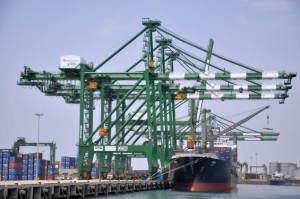
WASHINGTON: Converting cargo from road to rail, aimed at easing chronic congestion at Chennai Port, continues to be a struggle for authorities at India’s second-busiest public container harbor. Chennai’s rail share in fiscal year 2016 to 2017 through the end of March was down to 5.5 percent from 6 percent in the prior year, according to an analysis of port statistics obtained by JOC.com. During the year, inland export-import volumes moved by rail totaled 83,275 twenty-foot-equivalent units (TEUs) out of the port’s total throughput of 1.49 million TEUs, versus 93,494 TEUs and 1.56 million TEUs, respectively, last year. By contrast, Chennai’s share of over-the-road freight stayed almost flat with the previous year, at 94 percent, or 1.4 million TEUs, compared with 1.46 million TEUs, the data analysis shows.
The number of container ship calls at the port last year decreased to 705 from 755 previously, reflecting the loss of some mainline services to nearby private ports such as Kattupalli and Krishnapatnam. At the same time, Chennai’s overall average container dwell times marginally improved during the year, to 2.63 days from 2.95 days in fiscal 2015 to 2016, productivity statistics show. The Chennai port complex encompasses DP World-operated Chennai Container Terminal and PSA International’s Chennai International Terminals, with a combined capacity of roughly 3 million TEUs per year. Congestion caused by lengthy truck turnarounds has long been an operational nightmare for shippers and container lines using terminals at Chennai and as a result, growth at the largest East Coast public gateway has remained stagnant for years.

To address those issues, the port authority in coordination with state-owned rail operator Container Corporation of India (Concor) has introduced new train services, including time-guaranteed runs, and tariff incentives. Accelerating that push, the port authority is also working with railway authorities to build a dry port at Jolarpet, about 140 miles from the harbor, to help capture freight hauled by trucks on the route, which accounts for roughly 50,000 TEUs annually, according to port estimates. Although those are positive signs, the solution is not so simple given the huge price differential between rail and road, and strained rail networks. But the Narendra Modi government is trying to turn things around. It has set up a separate company — Indian Port Rail Corporation Limited — based on equity participation from major port authorities and Indian Railways to speed development of last-mile rail projects. This company has already been awarded contracts for 22 port-rail projects with a total estimated investment of Rs. 20,000 crore (about $3 billion).
Further, authorities are working toward an “integrated multimodal logistics and transport policy” to switch from a point-to-point transportation system to a hub-and-spoke model that will facilitate the movement of domestic freight on lower-volume corridors. That plan provisionally calls for construction of 50 economic corridors nationwide and a revamp of major feeder and inter-corridor routes. “Transformation of the logistics sector is only possible through an integrated system-based approach that cuts across modes of transport, administrative geographies, and integrates capital investment with regulatory and policy development,” Indian road transport and shipping minister Nitin Gadkari said in a recent statement. The overriding goal of those government efforts is to slash logistics costs that currently represent about 18 percent of India’s GDP.
