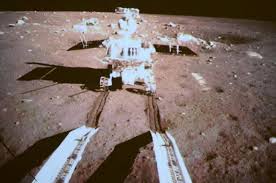
n 2013, China became the most recent nation to land hardware on the Moon. It successfully placed the Chang’E 3 lander on the surface of the Mare Imbrium, near the lunar north pole. The lander then deployed a rover named Yutu, which explored the surface for several weeks before suffering a mechanical failure. Communications with the rover were lost completely earlier this year.
The Chang’e 3 lander and Yutu rover make the first soft Moon landing in 37 years.
Often forgotten in the focus on the rover is the fact that Chang’E 3 had a variety of scientific instruments on board. And recently, the scientists behind one of them provided a progress update on their hardware, a UV telescope. Despite the harsh lunar environment, the telescope has now sent back 18 months of data and is still going strong.


UV radiation is more energetic than visible light and marks some of the Universe’s most active processes, such as star formation. But it can’t be done from Earth, as our atmosphere (thankfully) absorbs most UV radiation. As such, it has primarily been pursued using orbital observatories.
Of course, lacking an atmosphere, the Moon provides the same advantages as being in orbit. But it does have a number of significant disadvantages: a harsher environment, greater distance from Earth, and a reduced telescope mass, since it has to be successfully landed on the planet. Still, if we ever do set up occupancy on the Moon, it might make sense to place an instrument there, since it could be easier to service than one in orbit.
The people behind Chang’E 3 seemed to have decided that it might be worth testing out whether the concept really did make sense. While their telescope, called the Lunar-based Ultraviolet Telescope (or LUT), is quite small (its aperture is 150mm), it can obtain UV images of astronomical objects and serve as a test bed to get the Chinese space program experience with robotic telescopes.
To deal with the lunar environment, the operating procedure takes into account the dust that’s prevalent on the Moon. It’s thought that this is sometimes kicked off the surface by the change in state that occurs as the day/night border sweeps across the Moon, so the telescope doors are shut during this time. The authors also estimate that the mirrors on the scope will be struck by 1017 high-energy protons from the Sun during 18 months of operation, which really can’t be avoided.
The team worked with a catalog of 44 well-characterized stars within the field of view of the LUT, imaging them regularly over the 18 months in question. And they found no degradation in the telescope’s performance over that time.
While the science achievements of LUT are likely to be modest compared to many of the orbiting observatories we’ve put up, it represents a big technical achievement for the Chinese space program and may signal that nation’s intention to work on space-based observatories. Plus it’s just neat to be able to look at the Moon and know there’s an operational telescope on it.