
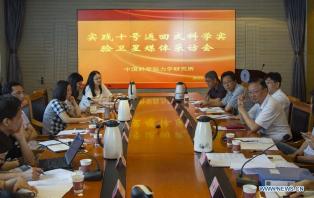


BEIJING: Chinese scientists are planning to launch a retrievable scientific research satellite in the first half of 2016.
The satellite – SJ-10 – will carry out research in microgravity and space life science to provide scientific support to manned space missions and space scientists on Earth, said project chief Hu Wenrui. All key components of the satellite have been tested and are functioning well, and it is expected to launch from the Jiuquan Satellite Launch Centre in northwest China’s Gansu province.
The satellite will carry out 19 experiments in six fields included microgravity fluid physics, microgravity combustion, space material science, space radiation effect, microgravity biological effect and space biological techniques, Xinhua reported.
Eight experiments in fluid physics will be conducted in the orbital module, and the other experiments will be conducted in the reentry capsule, which is designed to return to Earth after 12 days in orbit. The orbital module will keep operating in orbit for three more days.
According to Huang Chenguang – vice head of the Institute of Mechanics with the Chinese Academy of Sciences (CAS) – the SJ-10 is the second satellite in a space studies programme consisting of five scientific satellites. The SJ-10 project has been carried out under 11 institutes of the CAS and six Chinese universities in cooperation with the European Space Agency and Japan Aerospace Exploration Agency.
The first satellite of the space studies programme is a dark matter particle explorer satellite, expected to be launched by the end of this year. The programme also plans to launch a satellite for quantum science experiments and a hard X-ray telescope for black hole and neutron star studies within the next two years.

Karachi Port sets 138-year cargo handling record
KARACHI: Pakistan's maritime sector has achieved a major milestone as Karachi Port set a new record in its 138-year history...


