

Customs Today
  • Home
  • Islamabad
  • Karachi
  • Lahore
  • National
  • Transfers and Postings
  • Chambers & Associations
  • Business
No Result
View All Result
Customs Today
  • Home
  • Islamabad
  • Karachi
  • Lahore
  • National
  • Transfers and Postings
  • Chambers & Associations
  • Business
No Result
View All Result
Customs Today
No Result
View All Result
Home Science & Technology Science

Coral reefs likely to disappear from planet by mid-century

byCustoms Today Report
31/08/2015
in Science, Science & Technology
Share on FacebookShare on Twitter

You might also like

Tesla driverless system to use updated radar technology

12/09/2016

Apple to develop its own self-driving technology

10/09/2016

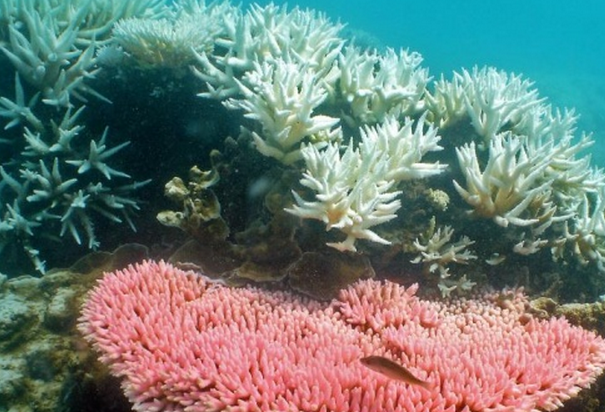
LONDON: Coral reefs are likely to disappear from the planet by mid-century even if world leaders agree on efforts to limit a temperature increase to less than two degree Celsius by the end of the century at December’s Climate Change Conference (COP21) in Paris, scientists have warned.
“Even if Paris is wildly successful, and a treaty is struck, ocean warming and ocean acidification are going to continue beyond the end of this century,” said professor Peter Sale from University of Windsor in Ontario, Canada.
Speaking at a plenary session of the ongoing Goldschmidt 2015 conference, one of the world’s major gathering of geochemists, in Prague, Czech Republic, Sale said he sees little hope for reefs unless the world embarks on a more aggressive emissions reduction plan.
“This is now serious; I find it very unlikely that coral reefs as I knew them in the mid-1960s will still be found anywhere on this planet by mid-century. Instead, we will have algal-dominated, rubble-strewn, slowly eroding limestone benches,” Sale pointed out.
Coral reefs are hot spots for bio-diversity and crucial for the economies of many coastal communities.
Besides providing habitats and shelter for many marine organisms, they protect coastlines from the damaging effects of wave action and tropical storms.
They are now considered one of the most vulnerable ecosystems to future climate change due to rising sea surface temperatures and ocean acidification, which is caused by higher atmospheric levels of carbon dioxide (CO2).

Related Stories

Tesla driverless system to use updated radar technology

byCT Report
12/09/2016

WASHINGTON: Electric carmaker Tesla announced Sunday it was upgrading its Autopilot software to use more advanced radar technology. In a...

Apple to develop its own self-driving technology

byCT Report
10/09/2016

SAN FRANCISCO: Apple may not become an automaker, but it still wants to develop its own self-driving technology. The iPhone-maker's...

NASA spots slowest known magnetar

byCT Report
10/09/2016

WASHINGTON: Astronomers have found evidence of a magnetar - magnetised neutron star - that spins much slower than the slowest...

‘YouTubers’ outshining old-school television

byCT Report
09/08/2016

SAN FRANCISCO: A media revolution is taking place, and most people over 35 years of age aren’t tuned in. Millennial...

Next Post

India's coffee exports fall by 7.59% to about USD 64m in July 2015

  • Terms and Conditions
  • Disclaimer

© 2011 Customs Today -World's first newspaper on customs. Customs Today.

No Result
View All Result
  • Transfers and Postings
  • Latest News
  • Karachi
  • Islamabad
  • Lahore
  • National
  • Chambers & Associations
  • Business
  • About Us

© 2011 Customs Today -World's first newspaper on customs. Customs Today.