

CANADA: The galaxies throughout our universe are grouped into galactic clusters, each of which possess several dead galaxies in which stars cease to form. Now, research suggests that “red and dead” galaxies can be resurrected with giant cosmic tsunamis.
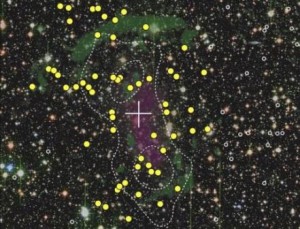
A new study in the journal Monthly Notices of the Royal Astronomical Society by astrophysicists Andra Stroe of Leiden Observatory and David Sobral of the University of Lisbon documents their observation of the merging galaxy cluster CIZA J2242.8+5301 (known as the “Sausage” galaxy), and found 2.3 billion light-years away from our planet.
They recorded their observations with the Isaac Newton and William Herschel Telescopes on La Palma, as well as the Subaru, CFHT and Keck Telescopes of Hawaii. Stroe and Sobral discovered that these cluster galaxies were struck by a shock wave, which afterward triggered the birth of new stars.
This so-called tsunami is the result of a violent collision among galactic clusters, which move at six million miles per hour, dragging a great deal of volatile galactic gas. An avalanche-like event takes place, leading to the formation of very dense clouds that trap these gasses inside – the ingredients necessarily to jump start stars again.
“Star formation at this rate leads to a lot of massive, short-lived stars coming into being, which explode as supernovae a few million years later,” Sobral said in a release. “The explosions drive huge amounts of gas out of the galaxies and with most of the rest consumed in star formation, the galaxies soon run out of fuel. If you wait long enough, the cluster mergers make the galaxies even more red and dead – they slip back into a coma and have little prospect of a second resurrection.”

Karachi Port sets 138-year cargo handling record
KARACHI: Pakistan's maritime sector has achieved a major milestone as Karachi Port set a new record in its 138-year history...