HAVANA: The government has confirmed that during 2014 it spent over $1.6 million on the detention, housing and repatriation of Cuban migrants who arrived in the Cayman Island illegally. Following calls from the Cayman Islands Red Cross, as it marked World Refugee Day this weekend, not to think about refugees in terms of dollars and cents, that bill may be even more in 2015 as the numbers of migrants passing through local waters continues to increase.
Although many vessel do simply pass by, in the last few weeks more than 60 Cuban refugees have been detained by law enforcement officials. Following the repatriation to Cuba of three remaining migrants at the George Town detention centre in Fairbanks on 15 May, the facility was closed. But just a few weeks later, starting on 10 June, a new wave of migrants has seen 63 refugees detained at the centre.


Government officials said this week that a number of law enforcement agencies were involved in life-saving operations recently involving two groups.
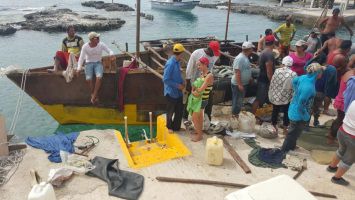
One group was rescued at sea off the coast of Little Cayman on 10 June, saving the lives of the 18 people on a boat that was dead in the water (right).
Then, according to a release from the home affairs ministry Tuesday, four law enforcement agencies — the prison service, customs, immigration and police — were involved in preventing 37 Cuban nationals who arrived on Cayman Brac on Saturday from trying to continue their journey in what was described as a leaking vessel.
A spokesperson stated that some of the migrants were sick and injured and there were no life jackets on the makeshift boat. The deteriorating vessel had carried 27 men and ten women from the neighbouring island of Cuba into local waters and they were first sighted on Saturday 20 June off Cayman Brac.
Investigations revealed that the group were headed, like most other migrants passing through Cayman waters, to Honduras. But officials said they had insufficient fuel and oil for the journey, the rudder of the vessel was bent and in need of repair and the boat was leaking significantly.
“By the time officers from Grand Cayman arrived on Cayman Brac, the Cubans had removed most of their belongings from the vessel, placing them on the ground while attempting to make repairs,” a ministry release stated.
Officials determined that the vessel was not seaworthy and immigration enforcement officers told the Cubans that they would not be permitted to continue their journey based on the condition of the vessel as well as the lack of fuel and life jackets, and that they would have to be detained pending repatriation.
The Cubans were said to have been transported from Panama Canal, the area where they had landed in Cayman Brac, to the Charles Kirkconnell International Airport.
A Cayman Airways 30-seat aircraft carried the ten women and five of the men to Grand Cayman and the remaining 22 men were transported in a second wave via the CAL jet service.
“The overall operation was successful with no injuries to either the migrants or the officials and there is no doubt this operation saved the lives of these migrants,” said Home Affairs Ministry Chief Office Eric Bush.
In April officials from the Cayman Islands and Cuba signed a new memorandum of understanding to help speed up the process of repatriating Cuban migrants who land in Cayman illegally. The government stated that the MoU will be reviewed annually but they have still not released the document, which remains under wraps.
Despite the increasing numbers of migrants moving towards the US, based on the fears that the Obama administration may repeal the ‘wet-foot, dry-foot’ policy regarding Cuban migrants as the two countries normalize relations, the Cayman government has not budgeted a sufficient amount to deal with Cuban refugees.
With an appropriation of just $250,000 in the 2015/16 budget to deal with illegal migrants, government will be facing a significant shortfall in a very short space of time if the pace of migration continues. However, during Finance Committee government officials said that because there was no way to know how much would be required, a notation was made in the Annual Plan and Estimates indicating that government was expecting to finance the appropriation on a needs basis.