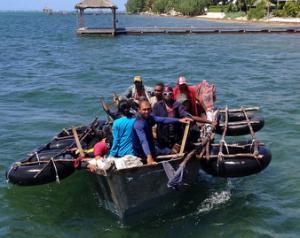
HAVANA: The number of Cuban migrants seeking to enter the United States ballooned in early 2015, partly driven by uncertainty over the future of special immigration consideration for Cubans after the two countries announced efforts to improve ties.


In the first three months of the year, 9,371 Cubans arrived in the U.S., mostly on the border with Mexico and in Miami, Florida — an increase of 118 percent over the same period in 2014, according to U.S. Customs and Border Protection.
Migration experts say the numbers indicate a surge since the Dec. 17 announcement by Barack Obama and Raúl Castro to restore diplomatic ties and work to normalize relations after more than 50 years of hostility.
“Cubans on the island are increasingly concerned that the special legal status that they have under current U.S. law might be taken away,” Jorge Duany, director of the Cuban Research Institute at Florida International University, told Reuters.
Under the Cuban Refugee Adjustment Act of 1966 Cubans who reach U.S. soil have the right to stay and seek residency, a status not offered to any other nationality. The policy, known as “wet foot, dry foot,” means only those Cubans intercepted at sea are sent back to Cuba.
The Obama administration has tried to dispel rumors the welcome mat for Cubans will be withdrawn.
“The Administration’s recent announcement regarding Cuba has not changed or altered in any significant way the Cuban Refugee Adjustment Act,” the Customs and Border Protection agency said in a statement.
Some have argued the policy — meant at the time of its inception to be a lifeline for political refugees from Cuba after its 1959 revolution — has outlived its usefulness.
Despite assurances that the law will not be changed any time soon, Cuban migrants continued to rush to make the journey to the U.S.
Lady Castillo Miranda, a Cuban immigrant in Miami, said she had attempted two crossings in the last two years. “I had to try again because I heard the law was going to change,” she said.
Many cross the 90-mile Florida Straits on makeshift rafts, but Cuban migrants are increasingly taking a land route in their attempt to reach the U.S., reports show.
Cuban migrants are increasingly traveling to Ecuador, where they don’t need a visa, and then to Colombia, Central America, Mexico and eventually the U.S., the BBC reported last month.
A series of reports on detentions of Cuban migrants appeared to generally trace that route from South America to Central America.
Last week, 24 Cubans were detained in Colombia near the border with Panama as they attempted to migrate to the U.S., Miami-based Marti News, a U.S. government-funded news website aimed at broadcasting news to Cubans, reported.
Another group of Cuban migrants was detained in Ecuador and Colombia last month. The migrants apparently were traveling to Panama and then on to the U.S., the Colombian daily El Pais reported.
This year Honduran authorities have detained more than 1,800 Cuban immigrants, according to Marti News. Most of them were traveling to the U.S.