

LONDON: Mars is frequently viewed as having a fairly uniform surface of basaltic rock, the type of dense rock that makes up most of Earth’s ocean crust. However, new findings made using the ChemCam on the Curiosity rover suggest that it may once have been different.
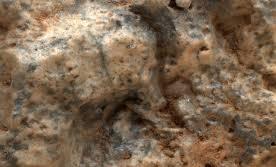
The ChemCam which uses lasers to analyze the composition of rocks it encounters recently came across unusually light colored rocks, similar to those found in the continental crust of Earth.
“Along the rover’s path we have seen some beautiful rocks with large, bright crystals, quite unexpected on Mars. As a general rule, light-colored crystals are lower density, and these are abundant in igneous rocks that make up the Earth’s continents,” said Roger Wiens of Los Alamos National Laboratory, lead scientist on the ChemCam instrument, in a statement.
The rocks were found inside the Gale Crater, where Curiosity landed. According to the researchers they are about 4 billion years old and are rich in feldspar and possibly quarts, making them similar to rocks contained in Earth’s continental crust.
The 22 rock samples analyzed bear a strong resemblance to Tonalite-Trondhjemite-Granodiorite or TTG according to Violaine Sautter. Sutter is first author of the new study which appears in Nature Geoscience.
TTG was a dominant feature in the continental crust of the Earth more than 2.5 billion years ago, during the Archean era.

Karachi Port sets 138-year cargo handling record
KARACHI: Pakistan's maritime sector has achieved a major milestone as Karachi Port set a new record in its 138-year history...