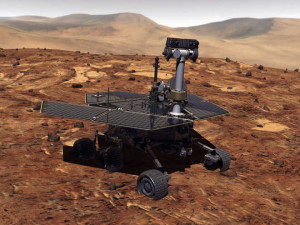


NEW YORK: Old school geology can’t really be done by helicopter. It requires boots and hammers on the ground, interrogating rocks until they give up their identities and reveal their histories. Planetary geologists are pretty much trapped in helicopters, analyzing whatever can be measured by passing or orbiting spacecraft.
But there are some rare exceptions. What the Mars Curiosity rover lacks in hammers, it more than makes up for in lasers. With those armaments, Curiosity is uncovering some basics of Martian geology that can fill in portions of the history we’ve gleaned from orbit.
Mars’ crust is dominated by rocks produced through volcanism. It seemed to lack Earth’s igneous diversity, however, and little is known about Mars’ early volcanic history around 4 billion years ago. But that’s exactly how old the rocks of Gale Crater, where Curiosity spends its roving days, are.
One of the most basic divisions of igneous rocks is drawn along chemical lines. Dark-colored “mafic” rocks contain lots of magnesium- and iron- (Fe) bearing minerals (think basalt). Lighter-colored “felsic” rocks contain more of the minerals feldspar and quartz (SiO2)—think granite. Satellite imagery of Mars shows that it’s surface is largely mafic rock, but we’ve identified some limited patches of light-colored rock that seemed to contain feldspar and quartz. Remember, however, that helicopter geology is hard. The presence of felsic rocks was not without some ambiguity.

Karachi Port sets 138-year cargo handling record
KARACHI: Pakistan's maritime sector has achieved a major milestone as Karachi Port set a new record in its 138-year history...