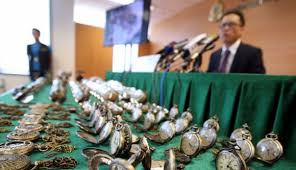
KINGSTON: Commissioner of Customs Major Richard Reese says approximately 230 breaches of 11 sections of the Customs Act were detected in the first quarter of the fiscal year 2016/2017.
Reese was speaking yesterday at a press briefing hosted by the Jamaica Customs Agency’s (JCA) at its head office in Kingston, where he and other JCA officials provided updates on various projects, and provided an overview of the financial standing of the agency, among other issues.


“These infractions ranged from unauthorised interference with cargo while in/or being conveyed between ports, customs area, container station or inspection site and this primarily speaks to the breaking of seals…,” Reese told reporters.
He added that other infractions included the unauthorised interference with goods in private warehouse; failure to produce warehoused goods on request by an officer; the unlawful removal or embezzlement of warehoused goods, false declaration, concealment and importation of goods without the required permits.
Reese stated that for the period April to June, permit breaches of 173 cases accounted for 75 per cent of the infractions committed, while false declaration to the commissioner of customs (44 cases) accounted for 19 per cent of the breaches.
He stated that the revenues collected in respect of fines and forfeitures amounted to just over $22 million and accounted for one per cent of the non-tax revenue for the JCA.
Reese also told the press that the Customs, at the end of the first quarter, had net revenue of just over $44 billion, surpassing its targets by a little over five per cent.
“When compared to the first quarter of the financial year 2015/2016, the agency recorded growth in net revenue collection by 13 per cent or approximately $5.2 billion up from $39.016 billion in 2015,” the customs commissioner stated.
He added that the main drivers of the quarter’s revenue included automotive diesel oil, motor spirits (unleaded 87 and 90), cigarettes and motor vehicles. Other significant contributors included cellphones, tiles, bus and car tyres, motor vehicle parts and accessories.
Reese also gave an update on legislative amendments of the Customs Act, which he said had been done in three phases.
According to the commissioner, phase one ended in the passing of the Customs (Amendment) Act 2014 where the primary focus was to provide the legislative framework for the implementation and assimilation of the Automated System for Customs Data (ASYCUDA World) system.
“Phase two culminated in the laying before Parliament of the Customs Amendment 2015 Bill which was before the Joint Special Select Committee before the dissolution of Parliament this year. What is to happen now is for that bill to be laid again by the minister of finance and another joint select committee appointed,” Reese said.
In addition, he said certain amendments that were contemplated for phase three will be considered for inclusion in phase two.
He pointed out the they are currently in phase three where the JCA is engaged in extensive consultations with a number of stakeholders, including the Shipping Association of Jamaica, various ministries, departments and agencies of Government.
“This phase will allow the JCA to align, in law and in operations, with the World Trade Organization’s Trade Facilitation Agreement. The cost of this process is far outweighed by the benefit of improving the flow of goods into and out of Jamaica,” Reese stated.
The commissioner added that the phase three will also focus on several areas with a view to completing the modernisation of trade facilitation mechanisms.