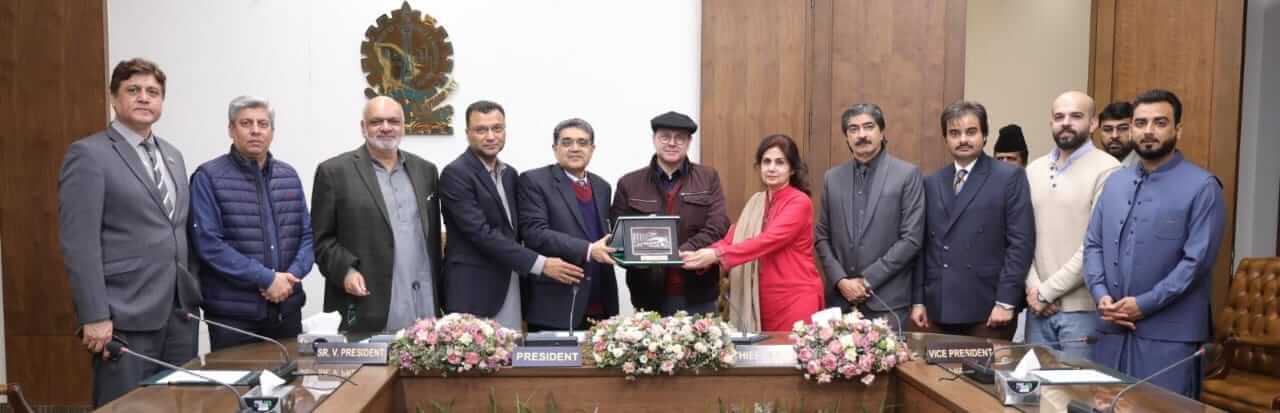
LAHORE: Director General of Valuation pledges fair assessments, expansion of Lahore office to facilitate business community
The Directorate of Valuation, Pakistan Customs, has assured traders that valuation matters will now be addressed in Lahore instead of Karachi, easing the burden on the business community.


Speaking at the Lahore Chamber of Commerce and Industry (LCCI), Director General Syed Hamid Ali emphasized that valuation processes would be conducted transparently and fairly, ensuring goods are assessed at appropriate rates.
Director General Syed Hamid Ali also acknowledged the concerns of the business community and agreed with LCCI President’s proposal to address valuation matters within Lahore itself, thereby eliminating the need for traders to travel to Karachi.
He assured that valuation processes would be conducted fairly and transparently to ensure that goods are valued at their appropriate and justifiable rates. Furthermore, he stated that the Lahore office’s capacity would be expanded to better facilitate local traders.
LCCI President Mian Abuzar Shad said that valuation-related meetings are traditionally held in Karachi, causing inconvenience to traders from Lahore and other up-country regions.
He proposed that if at least ten valuation requests originate from Lahore, the relevant meetings should be held in the city to save time and financial resources for the business community. Similarly, he suggested that valuation review meetings should also be conducted in Lahore to provide relief to traders from the up-country regions.
He said that, at times, the valuation of imported goods is set at retail prices, which are inherently higher than wholesale prices. He explained that an importer typically sells goods to wholesalers at minimal profit margins, while wholesalers then supply these products to retailers at higher profit margins. The retailers, in turn, determine their own pricing for the market. Given that retail prices vary across different markets, he argued that using market prices as the basis for valuation is not a justified approach.
Mian Abuzar Shad also pointed out that customs authorities often rely on market inquiries and import data to determine valuations using the Work Back Method. However, he stressed that they must consider that bulk consignments are booked in containers, which naturally results in lower unit prices recorded in import documents.
Additionally, he proposed that the fundamental criteria for market inquiries should be formally notified so that importers can calculate their expected valuation in advance. He also suggested that if input from importers is required, they should be notified at least ten days prior to ensure proper compliance.
LCCI Senior Vice President Engineer Khalid Usman expressed concerns that importers often face immediate implementation of new valuation rulings, which can lead to significant financial losses. He recommended that there should be a one-month grace period before the enforcement of new valuation rulings so that importers can adjust accordingly.