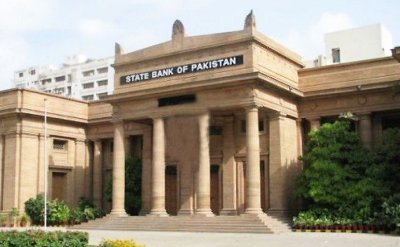
KARACHI: State Bank of Pakistan, in its second quarterly report for FY16, has lauded economic stability in the country and termed this progress the result of SBP’s decision to cut policy rates in September 2015.
According to the report, improvements in some of the macroeconomic indicators are reflected in subdued CPI inflation, adequate FX buffers; stable exchange rate, low current account deficit despite a sharp decline in exports, and an improved fiscal position.


The Report said that the impact of oil price decline was felt directly on CPI inflation, which was pulled down to only 2.5 percent during the period. While lower prices have benefited consumers, these also have had an impact on farmers’ incomes and affected their cropping decisions. Cotton production has declined sharply this season, but the overall losses in crop sector are now expected to be modest, with good prospects of wheat crop. Initial estimates suggest that timely rains and better input availability have reportedly improved the per-acre harvest, increasing hopes for a bumper crop for the third straight year.
To make Pakistan’s growth more sustainable, the report suggests that the cost of production and doing business has to be brought down; energy supplies must be smoothened further especially via investing in more broad-based and sustainable sources of generation; and export-friendly industrial policies should be laid out.
The impetus to GDP growth, according to the report, is likely to come from vibrancy in domestic construction, as well as an increase in LSM growth from 2.7 percent in H1-FY15 to 3.9 percent YoY in H1-FY16. While higher development spending by the government set the momentum for domestic construction activity, the increase in LSM growth was supported by better energy management; lower commodity prices; and accommodative policies (for instance, higher PSDP spending, Apna Rozgar scheme, and multi-decade low interest rates).
The report also stated that these official FX inflows helped in financing the current account deficit during the period, and compensated for insufficient private investment inflows. The overall current account deficit reached $1.4 billion during H1-FY16, significantly lower than the $2.5 billion deficit recorded in the same period last year. Lower oil prices in the international market played an important role in reducing the deficits in the trade and services accounts. The country’s FX reserves reached a record-high level of $20.8 billion at end-December 2015; this is equivalent to 5 months of the country’s import bill.
The encouraging aspect, the report noted, is that the higher development spending did not impede the government’s fiscal consolidation efforts, as the overall budget deficit dropped appreciably to 1.7 percent of GDP in H1-FY16, from 2.4 percent of GDP in H1-FY15. This performance is attributed to better revenue generation as well as a decline in non-development spending. Government revenues have grown by 14.6 percent during H1-FY16 on the back of additional tax measures that the government took during the 2nd quarter. Not only has the government been able to reduce the fiscal gap, but the availability of external funding also enabled it to shift its financing away from domestic resources.
According to the report, Pakistan’s public external debt servicing obligations are not more than $6 billion per annum until 2020. This amount appears manageable, especially keeping in view the existing level of country’s FX reserves and expected continuation of FX inflows. The report however has projected that strong domestic demand, and a potential revival in investment in the country, will generate additional demand for imported capital goods and raw materials, which will be challenging to finance if FX earnings fail to keep pace.