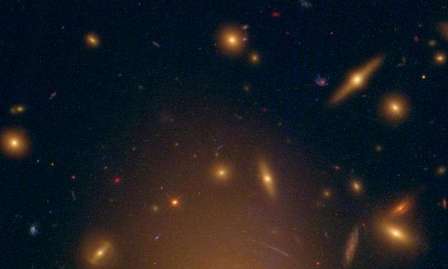


MEXICO: Dark matter is thought to account for much of the mass present in the universe, yet it remains undetectable by direct observation. Scientists rely on observations of visible space objects to determine the presence of dark matter.
It is believed that one gravitational effect of dark matter’s mass is that it can bend light from distant objects as the light travels through space-time. Using this effect – called gravitational lensing – to observe galaxies that would be otherwise hidden behind other galaxies in direct line-of-sight, scientists have observed that dark matter seems to be gathered in large amounts near galaxies and galaxy clusters.
Now, according to a Nature report, scientists have found an example of dark matter apparently not interacting with galactic gravity as would be predicted. The galaxy cluster Abell 3827 asserts a gravitational lensing affect on light from a galaxy hidden beyond it in such a way as to indicate that the dark matter nearby is not following along with the cluster’s gravity, but rather is affected by some unseen and unknown force.
The colliding galaxies in Abell 3827 show evidence of the dark matter within them interacting with other dark matter in some way that does not affect ordinary matter. Dark matter appears, in this instance, to have a nongravitational attraction to other concentrations of dark matter.

Karachi Port sets 138-year cargo handling record
KARACHI: Pakistan's maritime sector has achieved a major milestone as Karachi Port set a new record in its 138-year history...