HANOI: After the country’s exports of farm produce, seafood and forestry products declined in the first five months, the Mekong Delta is making efforts to boost its agricultural exports.
According to figures from the Ministry of Agriculture and Rural Development, exports of farm, fisheries and forestry produce were worth US$2.37 billion in May, taking the figure for the first five months to $11.4 billion, or down 7.3 per cent from the same period last year.


Exports in the first five months include $1.05 billion worth of rice, a year-on-year fall of 14.6 per cent; $2.41 billion of seafood (down 17 per cent); $1.2 billion of coffee (down 35.2 per cent); and $404 million of rubber (down 5.2 per cent).
Explaining the decline, the Ministry of Industry and Trade said a glut in these items has triggered fierce competition in the global market.
For instance, Vietnamese rice has to come up against competition from Thailand, India and Pakistan even as its traditional markets like China, Malaysia, and Indonesia are frozen and no new contracts have been won to export to any other market.
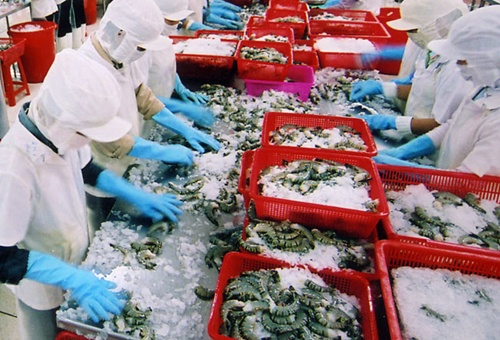
Vietnamese shrimp too has to compete with products from Thailand and India while demand in the US, Japan and Europe is on the decline. The decline in oil prices and changes in foreign exchange rates have also affected the exports.
Nguyen Van Dao, general director of the Tien Giang-based Godaco Seafood JSC, said: “Export of Vietnamese tra [catfish] has encountered difficulties this year. The decline in imports in the European markets and the devaluation of the euro is one of the main reasons. It makes tra fish breeders in the Mekong Delta unhappy.”
Deputy chairman of the Ca Mau People’s Committee, Le Dung, said shrimp exports from the Mekong province fell by 32 per cent in the first five months of 2015 because of a slump in demand in Europe, Australia, Japan, and Korea. Vietnamese exporters then shipped large quantities of shrimp to the US, causing prices there to go down sharply.
The decline in shrimp exports has pushed prices down in the delta, posing a big challenge for shrimp breeders, Sai Gon Giai Phong (Liberated Sai Gon) newspaper quoted Dung as saying.
To cope with the competition in overseas markets, Ca Mau authorities has asked Government agencies to provide businesses information about market demand, prices, and types of goods in demand to help exporters and farmers/buyers.
In the first five months of this year HCM City approved foreign direct investment of US$1.06 billion in both new and existing projects, up 34 per cent from the same period last year, according to its Department of Planning and Investment. Licences included work on 207 new projects worth $672.7 million. The figures indicate HCM City’s attractiveness at a time when other provinces and cities around the country are seeing a fall in FDI.
According to the Ministry of Planning and Investment’s Foreign Investment Agency, so far this year foreign investors have been licensed in 40 provinces and cities. Their registered capital was $4.29 billion, down 22 per cent from the same period last year.
HCM City topped the list followed by Dong Nai Province with $948.7 million and Hai Phong city with $319.3 million.
Foreign investment has mainly been in processing and manufacturing, at $3.15 billion accounting for a whopping 73.4 per cent of the country’s total FDI. The property sector was second with $461.5 million in 10 new and seven existing projects.
With the property market showing signs of recovering, there are already concerns that a scramble by banks to lend to it could cause another bubble like the one seen a few years ago, which inevitably ended up bursting. A rising demand for accommodation has accompanied the recovery, and experts say the revival owes much to money pumped in by banks.
A recent report by the construction ministry says that loans outstanding to the property sector as topped VND316.5 trillion (over $14.5 billion), up 4.8 per cent from December 31 and up 20.7 per cent on the previous December.
Nguyen Hoang Minh, deputy director of the State Bank of Viet Nam’s HCM City office, told Viet Nam Economic Times newspaper that HCM City-based banks’ credit growth this year was 4.5 per cent while loans to the property sector accounted for 13 per cent of total lending this year.
Banks have also launched promotions to attract borrowers in the property sector. VPBank said it would lend VND5 trillion at 6.99 per cent to clients for personal expenses and buying homes.
Banks are generally wooing property developers. At the ground-breaking ceremony for the VND3.5 trillion FLC resort complex in Quy Nhon city recently, Tran Bac Ha, chairman of BIDV, promised to provide 70 per cent of the money required for the project.
According to a report from the National Committee for Financial Supervision, credit growth has been 4.26 per cent in the first five months compared with 1.11 per cent a year earlier. The sharp increase is also an outcome of the improving economic situation.
Speaking at a real estate seminar in Ha Noi in early May, economist Vo Tri Thanh warned that the huge amount of money pumped in by banks into the property sector could create a bubble.
But financial and banking expert Nguyen Tri Hieu disagreed, saying the lending would be controlled, eliminating any risk of a bubble. Credit “barriers” have been put up by banks to eliminate risks right at the loan application stage, he added.
The SBV’s Minh agreed, saying a “bubble” is unlikely in the property market in the near future. Now banks carefully appraise the capacity of property investors, especially their financial wherewithal, before lending, he said.