LAHORE: The Punjab government on Monday unveiled Rs5.3 trillion provincial budget for the financial year 2025-26, having a record development outlay amid uproar from the opposition benches.
The total volume of the annual development programme has been set at an unprecedented Rs1,240 billion which was 47 percent more than the last year, but the opposition lawmakers turned down the budget proposals by tearing up the copies of the budget documents.

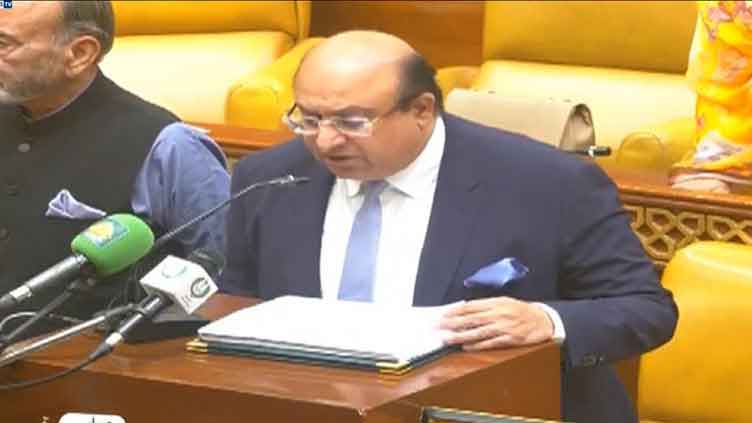
Punjab Finance Minister Mian Mujtaba Shujaur Rehman with a framed picture of PML-N President and former three-time minister Nawaz Sharif on his dais, presented the budget announcing a 10 percent raise in salaries of the government employees and a five percent increase in pensions.
As soon as he started his budget speech, the Opposition lawmakers were quickly on their feet denouncing the budget and tried to move towards Chief Minister Maryam Nawaz’s seat who was sitting in the first row in the Punjab Assembly.
Punjab Finance Minister Mujtaba Shuja-ur-Rehman unveiled the provincial budget 2025–26, declaring it tax-free once again and announcing a 10% salary and a 5% pension increase for government employees.
Addressing the assembly, the finance minister revealed that Rs7.60 billion has been earmarked for sports and youth affairs. This includes Rs5.16 billion for 96 ongoing schemes—such as hockey, squash, athletics tracks, the Chief Minister’s Sports Program, and “Khelta Punjab”—while Rs2.43 billion has been allocated for 88 new schemes.
Highlighting the development drive, the minister disclosed that Rs171.7 billion has been allocated for foreign-funded projects in the upcoming fiscal year.
In the health sector, two major initiatives were announced, including the Nawaz Sharif Institute of Cardiology to be established in Sargodha and the Jinnah Institute of Cardiology in Lahore.
In addition, emergency ambulance services will soon be introduced on motorways to handle accidents and emergencies more efficiently.
Praising Punjab Chief Minister Maryam Nawaz, the finance minister said her administration had “transformed the speed and quality of governance.”
He noted that 6,104 development projects were completed during her tenure—an unprecedented achievement in the province’s history.
He further shared that under the CM Punjab Laptop Scheme, launched with an allocation of Rs10 billion, 50,000 students have so far received laptops.
In a strong political statement, the finance minister condemned Israel’s state terrorism, urging the international community to hold Israel accountable for violating global laws. He also celebrated Pakistan’s diplomatic victory over India, calling it a historic success.
Punjab Finance Minister revealed that a record Rs2,706 billion has been allocated for non-development expenditures, including salaries, pensions, transfers, service delivery, and Provincial Finance Commission (PFC) awards. These expenses will see a 6% increase over last year.
In a major move to empower local governments, the minister announced a Rs764.2 billion allocation via PFC. Additionally, Rs150 billion will be granted to waste management companies and Rs20 billion to municipal corporations to improve urban services.
A Rs70 billion social protection package has been included for underprivileged citizens.
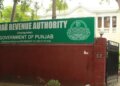
Punjab expects to receive Rs4,062 billion in federal transfers (via Federal Divisible Pool–FDP) and has set a provincial revenue target of Rs828.2 billion, including Rs340 billion from Punjab Revenue Authority (PRA), Rs135.5 billion from Board of Revenue, and Rs30 billion from Mines & Minerals.
Further estimates suggest Rs97.9 billion will be raised through foreign funding programmes, loans, and state trading.
As part of fiscal discipline under agreements with the federal government and the IMF, an EPS allocation of Rs740 billion is also included in the budget.
The finance minister announced that a substantial Rs661 billion has been allocated for non-development expenditures in education. Under the CM Punjab Laptop Scheme, a total of Rs37 billion—Rs27B for university students and Rs10B for college students—will be used to distribute 112,000 laptops. Additionally, Rs15 billion is allocated for merit scholarships, Rs4.5 billion for student stipends, Rs5 billion for improving school facilities, and Rs35 billion for the Punjab Education Foundation (PEF).
Punjab has earmarked Rs181 billion for development expenditures in the health sector Rs450 billion for non-development health costs.
He announced that Rs14 billion has already been released for the Nawaz Sharif Institute of Cancer Treatment and Research, with an additional Rs12 billion allocated this year; Rs2.6 billion for the Nawaz Sharif Institute of Cardiology; Rs109 billion for the establishment and land acquisition of the Nawaz Sharif Medical District; Rs9 billion for the Maryam Nawaz Health Clinic Programme; and Rs12.6 billion for the Maryam Nawaz Community Health Programme.
Mian Mujtaba Shuja-ur-Rehman announced that a substantial allocation of Rs150 billion has been earmarked for the “Apni Chhat” housing scheme, and Rs5 billion has been reserved to ensure the provision of clean drinking water.
He further stated that Rs 10 billion has been allocated to activate the provincial climate change authority, while Rs320 million has been set aside to provide free Wi-Fi at 400 public locations across Lahore.
The Energy Department has received a development allocation of Rs. 51.6 billion, with Rs. 14.2 billion specifically reserved for solar energy projects. Additionally, Rs3 billion will be used to install solar systems in government colleges.
For solarisation of session courts, Rs3.04 billion has been earmarked, while Rs400 million will be spent on solarizing government buildings. Another Rs1 billion will be allocated to transfer public hospitals to solar energy, and Rs750 million has been designated to convert high schools to solar systems. The Governor House Lahore will also be transitioned to solar energy, with a budget of Rs. 200 million.
A separate amount of Rs480 million has been set for hydel energy projects.
The Department of Literacy and Non-Formal Education has received a budget of Rs. 4 billion. Rs. 3.75 billion has been reserved for ongoing projects, and Rs. 249 million has been allocated for new educational initiatives. In Central Punjab, Rs1.059 billion has been allocated for non-formal education programs, while Rs50 million will go towards establishing literacy centers across the province.
The Punjab Department of Auqaf and Religious Affairs has been allocated a total of Rs. 3 billion. Among its various sub-allocations: Rs10 million will be used for installing an air cabinet at Data Darbar, and Rs10 million has been allocated for construction work at the shrine of Hazrat Shah Chiragh.
An amount of Rs60 million has been set for establishing a Central Command and Control Room under the Auqaf Department. Rs10 million has been allocated for the construction of the Islamic Centre Mosque in Johar Town. For the Langar Khana and Musafir Khana at the shrine of Mian Wada, Rs20 million has been designated.
Rs10 million will go toward mosque and boundary wall construction at the shrine of Hazrat Hassan Shah Wali. Another Rs10 million has been set for the reconstruction of the mosque at the shrine of Hazrat Pir Maki. Rs15 million has been allocated for building a mosque at the shrine of Shah Abul Maali, and Rs25 million will be used for development work at the shrine of Shah Kamal.
The shrine of Bibi Pak Daman will receive Rs100 million for the construction of a Langar Khana and Musafir Khana.
Punjab’s courts will be fully solarised, and the Energy Department will spend Rs3.0415 billion on this initiative. The Punjab Energy Efficiency and Conservation Agency is set to complete the full solarisation process by June 2027. A separate allocation of Rs2.8762 billion will be used to procure solar panels and related machinery and equipment.
Cabinet approves budget:
Earlier, the Punjab cabinet approved the provincial budget for the next financial year (FY), 2025-26, having a total volume of over Rs5,5335 billion.
According to the 24NewsHD TV channel, the cabinet approved a 10 percent increase in the salaries of government employees and a 5 percent increase in pensions, while the total volume of the development budget is proposed to be Rs 12.4 billion.
As per the schedule, the Punjab budget 2025-26 will be presented in the Provincial Assembly this afternoon.
According to the budget proposals, the allocation of Rs310 billion has been allocated for operating environment-friendly electric buses in the province, while amounts are also likely to be set aside for operating a train on Lahore’s Canal Road and a metro bus in Gujranwala.
Likewise, there is a suggestion to earmark Rs100 billion for school education, Rs39.50 billion for higher education, Rs5 billion for special education, Rs4 billion for literacy and non-formal education, and Rs7.60 billion for sports and youth affairs.
There is a proposal to allocate Rs95 billion for specialised healthcare and medical education for the next FY, Rs86 billion for health and population, Rs6 billion for water and sanitation, Rs7 billion for social welfare, Rs1.40 billion for women’s development, and Rs142 billion for local government and community development.
The allocation of Rs120 billion has been suggested for the construction of roads in the province; Rs38 billion for the irrigation department; Rs7.50 billion for the energy sector; Rs25 billion for public buildings; Rs145 billion for urban development; Rs80 billion for agriculture; Rs5 billion for forests; Rs10 billion for wildlife; and Rs10 billion for fisheries.
Similarly, there is a proposal to set aside Rs10.50 billion for price control and commodities management; Rs5 billion for livestock and dairy development; Rs12 billion for industry, trade and investment; Rs12 billion for skill development; Rs12 billion for mines and minerals; Rs35 billion for governance and information technology; Rs20.40 billion for labour and HR development; Rs85 billion for transport; and Rs12 billion for emergency services.
Likewise, an allocation of Rs15 billion for environment and climate change, Rs5 billion for information and culture, Rs10 billion for archaeology, and Rs3 billion for Auqaf and religious affairs has been proposed.
An amount of Rs4 billion is likely to be set aside for human rights and minorities, while Rs38 billion is for planning and development.