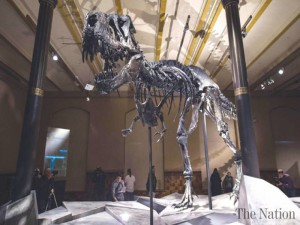
MIAMI: Dinosaurs struggled to survive for tens of millions of years before they finally went extinct, an event widely blamed on the environmental fallout from an asteroid strike, researchers have said.
The argument offers the latest salvo in a long-running debate among scientists over the state of dinosaur health in their final years on Earth – some say they were flourishing, while others say they were strongly in decline.
“While a sudden apocalypse may have been the final nail in the coffin, something else had already been preventing dinosaurs from evolving new species as fast as old species were dying out,” said lead author Manabu Sakamoto, a paleontologist at the University of Reading, in Britain. For the study in the Proceedings of the National Academy of Sciences, researchers combed through fossil records from around the world and performed a statistical analysis showing that various species of dinosaurs were going extinct at a faster pace than new ones were emerging for a period of at least 40 million years prior to the cosmic debris that smashed into what is modern-day Mexico.
“We were not expecting this result,” said Sakamoto.”While the asteroid impact is still the prime candidate for the dinosaurs’ final disappearance, it is clear that they were already past their prime in an evolutionary sense.”For instance, long-necked vegetarian sauropod dinosaurs – the largest land animals known to exist – were in the fastest decline, the study found.But theropods, the group that includes the iconic, meat-eating Tyrannosaurus rex, were disappearing at a more gradual pace.Factors in their struggle likely included the break-up of continental land masses and sustained volcanic activity, the study said.
Then, a giant asteroid collided in Mexico with the Earth – known as the Chicxulub impact – 66 million years ago, causing a massive dust storm that blocked the Sun and led to a period of global cooling and widespread plant death.Without trees and vegetation, an important food and shelter source disappeared, and so did the dinosaurs.”This suggests that for tens of millions of years before their ultimate demise, dinosaurs were beginning to lose their edge as the dominant species on Earth,” said Sakamoto.Even more, the research offers a look into the future. With many species already struggling due to human-driven climate change, those on the edge may be completely wiped out in the event of a disaster.”Our study strongly indicates that if a group of animals is experiencing a fast pace of extinction more so than they can replace, then they are prone to annihilation once a major catastrophe occurs,” Sakamoto said. “This has huge implications for our current and future biodiversity, given the unprecedented speed at which species are going extinct owing to the ongoing human-caused climate change.”