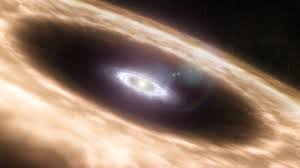


WASHINGTON: A team of astronomers led from St Andrews and Manchester universities announced the discovery of a ring of rocks circling a very young star. This is the first time these ‘pebbles’, thought to be a crucial link in building planets, have been detected. Dr Jane Greaves of the University of St Andrews presented the work at the National Astronomy Meeting at Venue Cymru in Llandudno, Wales.
Planets are thought to form from the dust and gas that encircles young stars in a disk. Over time, dust particles stick together, until they build up bigger clumps. Eventually, these have enough mass that gravity becomes significant, and over millions of years the clumps crash together to make planets and moons. In our own Solar System, this process took place about 4500 million years ago, with the giant planet Jupiter the first to form.
Since the 1990s, astronomers have found both disks of gas and dust, and nearly 2000 fully formed planets, but the intermediate stages of formation are harder to detect.
Dr Greaves and team colleague Dr Anita Richards from the University of Manchester used the e-MERLIN array of radio telescopes centred on Jodrell Bank, Cheshire, and that stretches across England in a so-called interferometer, mimicking the resolution of a single large telescope. Richards took charge of the image processing, which was initially meant just to test the handling of the very large data stream that e-MERLIN generates.

Karachi Port sets 138-year cargo handling record
KARACHI: Pakistan's maritime sector has achieved a major milestone as Karachi Port set a new record in its 138-year history...