

Customs Today
  • Home
  • Islamabad
  • Karachi
  • Lahore
  • National
  • Transfers and Postings
  • Chambers & Associations
  • Business
No Result
View All Result
Customs Today
  • Home
  • Islamabad
  • Karachi
  • Lahore
  • National
  • Transfers and Postings
  • Chambers & Associations
  • Business
No Result
View All Result
Customs Today
No Result
View All Result
Home Science & Technology Science

Dry climate kept plant eating dinosaurs away from tropics

byCustoms Today Report
18/06/2015
in Science, Science & Technology
Share on FacebookShare on Twitter

You might also like

Tesla driverless system to use updated radar technology

12/09/2016

Apple to develop its own self-driving technology

10/09/2016

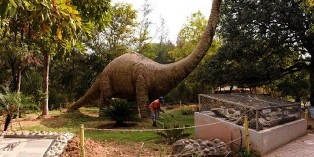
MALI: An unpredictable, yet scorching and dry climate kept large, grass-eating dinosaurs out of the tropics for some 30 million years after they first appeared on Earth, a study out Monday found. It has been a longstanding mystery: why did long-necked dinosaurs seem to avoid the tropics when there were many different types of them lived at different latitudes well north and south of the equator? There are fossil remains, however, of meat-eating dinosaurs in the tropics. Scientists working at a site in northern New Mexico worked with rocks from 215 to 205 million years ago and were able to recreate the climate from that time, the Late Triassic Period.
They found that the tropical climate varied greatly, but was usually too hot for plants, and as such for herbivores, to thrive. The carbon-loaded atmosphere had humid phases and then long droughts with temperatures of about 600 degrees. “Our data suggest it was not a fun place,” study co-author Randall Irmis of the University of Utah said in a statement. “It was a time of climate extremes that went back and forth unpredictably. Large, warm-blooded dinosaurian herbivores weren’t able to exist close to the equator – there was not enough dependable plant food.” An international team of researchers led by geochemist Jessica Whiteside had their findings published in the journal Proceedings of the National Academy of Sciences. “These scientists have developed a new explanation for the perplexing near-absence of dinosaurs in late Triassic equatorial settings,” said Rich Lane, program director in the National Science.

Related Stories

Tesla driverless system to use updated radar technology

byCT Report
12/09/2016

WASHINGTON: Electric carmaker Tesla announced Sunday it was upgrading its Autopilot software to use more advanced radar technology. In a...

Apple to develop its own self-driving technology

byCT Report
10/09/2016

SAN FRANCISCO: Apple may not become an automaker, but it still wants to develop its own self-driving technology. The iPhone-maker's...

NASA spots slowest known magnetar

byCT Report
10/09/2016

WASHINGTON: Astronomers have found evidence of a magnetar - magnetised neutron star - that spins much slower than the slowest...

‘YouTubers’ outshining old-school television

byCT Report
09/08/2016

SAN FRANCISCO: A media revolution is taking place, and most people over 35 years of age aren’t tuned in. Millennial...

Next Post

China to become largest cross-border e-commerce market by 2020

  • Terms and Conditions
  • Disclaimer

© 2011 Customs Today -World's first newspaper on customs. Customs Today.

No Result
View All Result
  • Transfers and Postings
  • Latest News
  • Karachi
  • Islamabad
  • Lahore
  • National
  • Chambers & Associations
  • Business
  • About Us

© 2011 Customs Today -World's first newspaper on customs. Customs Today.