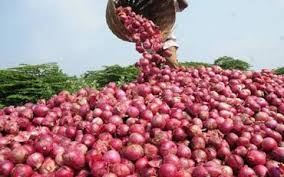
AMSTERDAM: The excessive import of onions from the Netherlands, a country that is affected by the presence of the Ditylenchus dipsaci nematode (Parasite), might affect the domestic production of onions and fruit exports of pineapple, banana and melon, according to producers.
These sectors could really be affecting exports of these products as exports of these products during the first quarter of 2017 decreased when compared to the same period of 2016. Banana exports went from $29 million 385 thousand last year, to $26 million 314 thousand in the same period of 2017, i.e. $3 million 71 thousand less.


Meanwhle, pineapple exports went from $4 million 754 thousand in the first quarter of in 2016, to $4 million 471 thousand this year.
Melon exports also decreased going from $2 million 656 thousand last year to $1 million 944 thousand this year.
Concerned about the situation in the Netherlands, the Association of Producers from Tierras Altas hired an expert to conduct a technical study to determine the risk to the national production if the plague entered the country.
Augusto Jimenez, a spokesman and adviser to the producers, said that when this type of plague entered a country it stayed in the country, and that fighting it was very costly. He also said that this plague was a danger because the Panamanian Authority for Food Safety (Aupsa) was not performing the proper controls for it.
“The proposal, duly supported by Francisco Dall’Anese Álvarez, is related to the need of applying strict standards of phytosanitary sanity norms to prevent the Panamanian soil from being contaminated by the Ditylenchus dipsaci nematode that affects some countries, including the Netherlands,” Jimenez said.
He said that the only solution was to ban the entry of onions from the Netherlands and that the Ministry of Agricultural Development (Mida), through the National Directorate of Plant Protection, had to correctly apply a phytosanitary measure.
He also said that they had given this report to the Minister of Agricultural Development, Eduardo Carles, on Thursday, and that he had promised to review it and send it to the Director of Plant Protection, Dario Gordon, who must sign it and send it to the World Health Organization (WHO).
“Once the document is sent, the WHO will have to inform the 164 members of the measure taken by Panama, which will be submitted for consultation for a period of 60 days before coming into effect,” Jimenez said.
He said that they expected and were waiting for the authorities to take this report into account and to sign it.
“We won’t allow more violations to our rights,” he said.
Dario Gordon, the director of the Department of Plant Protection, said that the document, which is already in the hands of Minister Carles, still hadn’t arrived in his office.
“I have not formally received any report, so I can not give a response to it,” he said.