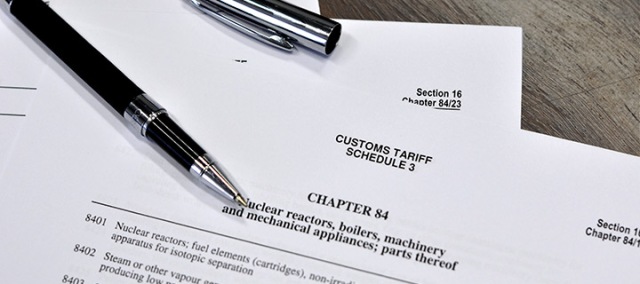
ISLAMABAD: The Federal Board of Revenue (FBR) will generate Rs32 billion through the withdrawal of duty concessions under SRO 567(I)/2006, SRO 567(I)/2006 and SRO 565(I)/2006 as well as reducing maximum customs duty rate from 30 to 25 percent, bringing down general tariff slabs from 7 to 6 in Pakistan Customs Tariff (PCT).
According to the revised customs tariff issued here, the government has announced reduction in the maximum tariff having revenue impact of Rs1.5 billion. The zero percent customs duty slab in tariff has been substituted with one percent. However, items considered socially sensitive are proposed to be maintained at zero percent duty through inclusion in Fifth Schedule to the Act. The revenue impact of the measure is Rs500 million.


The exemptions and concessions allowed under various SROs have been reviewed to minimize exemptions. Concessions considered non-essential, and to be minimally utilised be withdrawn. Concessions considered socially sensitive to be retained. Essential concessions retained on enhanced concessionary rates by incorporating them in newly added Fifth Schedule to the Customs Act.
The FBR has introduced major changes in SRO 567(I)/2006 and concessions to 7 sectors having import value below Rs30 million annually, and to sectors categorised as non-essential, are proposed to be withdrawn by shifting to normal tariff rates. The concessions to 25 sectors considered essential are recommended to be retained on proposed rates by shifting to fifth Schedule to the Act subject to the condition that the goods are ‘not locally manufacture red.’ The revenue impact of the proposal is Rs12 billion.
Under SRO 567(I)/2006, the concessions to 95 items having import value below Rs30 million annually are proposed to be withdrawn. The concessions to 11 items considered socially sensitive are proposed to be retained by shifting to Fifth Schedule to the Act. Concessions to 24 items considered non-essential are proposed to be withdrawn by bringing them under normal tariff rates. Concessions to 43 items considered essential are recommended to be retained on proposed rates by shifting to Fifth Schedule to the Act. The revenue impact of the measure is Rs9 billion.
Under SRO 565(I)/2006, the concessions to inputs of 89 products having import value below Rs30 million annually are proposed to be withdrawn. The extent of concessions on inputs to 62 products is proposed to be reduced. However, these concessions shall be subject to the condition that the inputs are not manufactured locally. Concessions to inputs of 6 products are proposed to be continued. The revenue impact is Rs 11 billion.
Through Finance Bill, the networking equipments are intermediary and finished goods. At present customs duty rates on these equipments are not based on cascading principle. Therefore it is proposed that customs duty on networking equipments may be rationalised.
The flat rolled products of alloy steel PCT codes 72.25 and 72.26, attract customs duty @0 percent and 5 percent respectively, whereas flat rolled products of non-alloy steel are subject to 10 percent customs duty. For avoiding misdeclaration and lab test, it is proposed that customs duty on flat-rolled products of alloy steel (PCT codes 72.25 and 72.26) may be increased from 0 to 5 percent to 10 percent to bring them at par with flat-rolled products of non-alloy steel. However, concession to fan industry at 0 percent shall be maintained by including the product in survey based SRO.
The government also has rationalised the exemption of duty and taxes on Hybrid Electric Vehicles (HEVs) in a bid to provide relief to public. But it also proposed Regulatory duty levied on luxury goods. As tariff rationalisation measures, the Federal Board of Revenue (FBR) granted 50 percent exemption of duty and taxes up to 1800 cc HEVs and 25 percent above 1800 cc.
The fixed amounts of duty and taxes on used vehicles revised upward by 10 percent approximately. Customs duty on flat-rolled products of alloy steel (PCT codes 72.25 and 72.26) increased from 0 and 5 percent to 10 percent to bring them at par with flat- rolled products of non-alloy steel. Customs duty @ 5 percent levied on import of generators above 1100 kVA (PCT code 8502.1390). A uniform rate of 15 percent customs duty levied on dyes except basic dyes (3204.1300) and indigo blue dyes (3204.1510) being used in textile sector. A uniform rate of 10 percent customs duty on all kinds of CDs/DVDs of PCT codes 8523.4000 levied.
The customs duty on flavouring powders (PCT code 2106.9030) enhanced from 10% to 20% to avoid misclassification. A uniform rate of 10 percent levied on Liquid paraffin (PCT code 2710.1995) and White oil (PCT 2710.1996) being same in nature. Customs duty on dryers (PCT code 8421.1900) increased from 5 percent to 10 percent.
A uniform rate of 15 percent levied on starches (PCT code 11.08) to rationalise duty structure and avoid classification disputes. Customs duty on colouring matters (PCT code 3206.4990) enhanced from 5 percent to 10 percent to reduce the chance of misclassification. Customs duty on satellite mobile phones whether or not from 25 functional on cellular networks (PCT code 8517.1230) reduced from 25 percent to 10 percent.
In order to encourage industrialisation and promote fruit cultivation, plant, machinery and equipment imported for setting up fruit processing and preservation industrial units in Gilgit-Baltistan, Balochistan and Malakand Division, exempted from whole of customs duty.
To generate employment and encourage industrialisation, plant, machinery and equipment imported for setting up industries in FATA, exempted from whole of customs duty. Customs duty on UPS (PCT code 8504.4010) reduced from 20 percent to 15 percent to provide relief to general public. Customs duty on petroleum coke not-calcined (PCT code 2713.1100) decreased from 5 percent to lowest slab of 1 percent to reduce input costs for manufacturing concerns.