

PARIS: First classified a planet, then an asteroid and then a “dwarf planet” with some traits of a moon – the more scientists learn about Ceres, the weirder it becomes.
And new observations of the sphere of rock and ice circling our Sun between Mars and Jupiter have added to the mystery, researchers said Monday.
Astrophysicists have been looking to a $473-million (446-million-euro) mission to test theories that Ceres is a water-rich planetary “embryo” – a relic from the birth of the Solar System some 4.5 billion years ago.
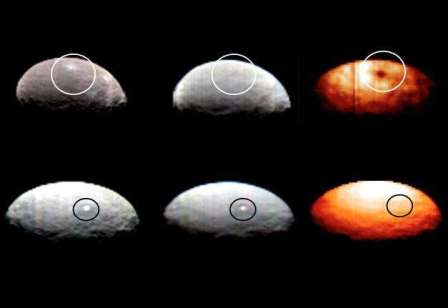
But an early batch of data from NASA’s Dawn probe, unveiled at a conference of the European Geosciences Union (EGU), may have made the Ceres riddle even greater. In orbit around Ceres since March 6 after a seven-and-a-half-year trek, Dawn peered at two bright spots on its surface deemed to be telltales of its chemical and physical ID. But instead of explaining the spots, analysis found the two seemed to “behave distinctly differently,” said Federico Tosi, who works on Dawn’s Visible and Infrared Mapping Spectrometer (VIR). While Spot 1 is colder than its immediate surroundings, Spot 5 is not.
The spots are two of a known dozen or so which on photographs taken by Dawn resemble lights shining on a dull grey surface. Ceres travels at some 414 million kilometres (260 million miles) from the Sun, taking 4.61 Earth years to complete one orbit. About 950 km (590 miles) wide, it is the biggest object in the asteroid belt – large enough for gravity to have moulded its shape into a ball.
With VIR, the Dawn team have been able to put together images at different wavelengths of light, Tosi told journalists. One picture, as seen by the human eye, shows Ceres as a “dark and brownish” ball with both white spots clearly visible. But in thermal images, Spot 1 becomes a dark spot on a reddish ball, indicating it was cooler than the rest of the surface, said Tosi.

Karachi Port sets 138-year cargo handling record
KARACHI: Pakistan's maritime sector has achieved a major milestone as Karachi Port set a new record in its 138-year history...