NEW YORK: It is a stunning example of how beautiful space can be.
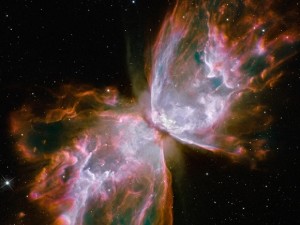
European Space Agency bosses have revealed amazing image of the so-called ‘butterfly nebula.


It shows the death throes of a star, when great clouds of superheated gas are expelled into space.
The image shows planetary nebula NGC 6302, captured from the NASA/ESA Hubble Space Telescope.
‘Known perhaps more appropriately as the Bug or Butterfly Nebula, this complex nebula lies roughly 3800 light-years away from us within the Milky Way, the agency said.
‘It was formed when a star around five times the mass of our Sun became a red giant, ejected its outer layers, and became intensely hot.
‘Its distinctive shape classifies it as a bipolar nebula, where fast-moving gas can escape more easily from the poles of the dying star than from around its equator.’
This creates a lobed structure reminiscent of an hourglass or, as in this case, a giant cosmic butterfly.
While this image is beautiful in its own right, the mix of colours actually tells us a lot about physical conditions within the nebula.
The red edges of the butterfly wings represent areas that emit light from the element nitrogen, due to the relatively low temperatures there.