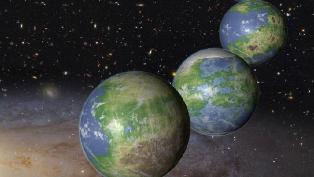
WASHINGTON: Earth came early to the party in the evolving universe, according to a new theoretical study. It concludes that only eight percent of potentially habitable planets have even formed yet.
But many future civilizations may arise so late that by then, evidence for the Big Bang—the explosion-like event that gave birth to the universe—will have disappeared.
The conclusion is based on an assessment of data collected by NASA’s Hubble Space Telescope and the prolific planet-hunting Kepler space observatory.
“Compared to all the planets that will ever form in the universe, the Earth is actually quite early,” said study author Peter Behroozi of the Space Telescope Science Institute in Baltimore, Md.
Looking far away and far back in time, Hubble has given astronomers a “family album” of galaxy observations that chronicle the universe’s star formation history as galaxies grew.
The data show, the researchers said, that the universe was making stars quickly 10 billion years ago, but the fraction of the universe’s hydrogen and helium gas that was involved to make those stars was very low. Today, star birth is happening much more slowly, but there is so much leftover gas available that the universe will keep cooking up stars and planets for a very long time.


“There is enough remaining material to produce even more planets in the future, in the Milky Way and beyond,” said co-investigator Molly Peeples of the institute.
Kepler’s planet survey indicates that Earth-sized planets in a star’s habitable zone, the perfect distance that could allow water to pool on the surface, exist all over our galaxy. Scientists predict there should be a billion Earth-sized worlds in the Milky Way galaxy now, a good portion of them presumed to be rocky, like ours. That estimate skyrockets when you include the other 100 billion galaxies in the observable universe.
This leaves plenty of opportunity, they said, for untold more Earth-sized planets in the habitable zone to arise in the future. The last star isn’t expected to burn out until 100 trillion years from now. That’s plenty of time for anything to happen on the planet landscape.
The researchers say that future Earths are more likely to appear inside giant galaxy clusters and also in dwarf galaxies, which have yet to use up all their gas for building stars and accompanying planetary systems. By contrast, our Milky Way galaxy has used up much more of the gas available for future star formation.