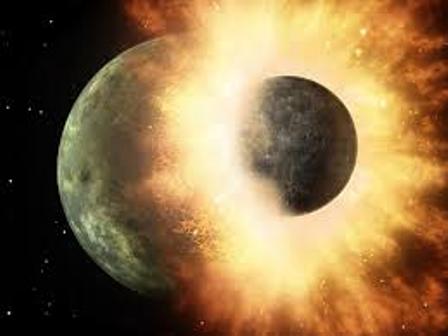


NEW YORK: It’s a lunar mystery that has lingered for decades: If the moon is made of material from another planetary body that crashed into Earth, why is its chemical fingerprint so similar to that of our planet?
Nobody is 100% sure how the moon was created, but the giant-impact model is the most widely accepted. It suggests that 4.5 billion years ago a proto-planet about the size of Mars collided with Earth during the turbulent formation of our solar system.
This theory explains a lot of the physics of the Earth-moon system. But there has been one major stumbling block: The material that makes up our moon is chemically very similar to the material that makes up the Earth. Too similar.
Computer models show that in the aftermath of the great smash most of the impactor body, known as Theia, would have accreted onto the Earth. However, a fraction of Theia’s debris would have been ejected and eventually coagulated to form the moon.

Karachi Port sets 138-year cargo handling record
KARACHI: Pakistan's maritime sector has achieved a major milestone as Karachi Port set a new record in its 138-year history...