Customs Today
  • Home
  • Islamabad
  • Karachi
  • Lahore
  • National
  • Transfers and Postings
  • Chambers & Associations
  • Business
No Result
View All Result
Customs Today
  • Home
  • Islamabad
  • Karachi
  • Lahore
  • National
  • Transfers and Postings
  • Chambers & Associations
  • Business
No Result
View All Result
Customs Today
No Result
View All Result
Home Science & Technology Science

Earthquakes can change elastic properties of the Earth’s crust

byCustoms Today Report
28/10/2015
in Science, Science & Technology
Share on FacebookShare on Twitter

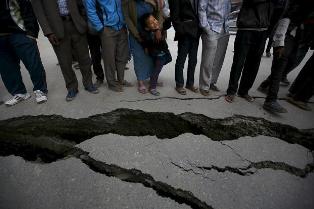
WASHINGTON: Earthquakes can change elastic properties of the Earth’s crust up to 6,000 kilometres away, altering its ability to withstand stresses for up to a few weeks, a new study has found.
The research demonstrates that the Earth is a dynamic and interconnected system, where one large earthquake can create a cascading sequence of events thousands of kilometres away, researchers said.

“Earthquakes can fundamentally change the elastic properties of the Earth’s crust in regions up to 6,000 kilometres away, altering its ability to withstand stresses for a period of up to a few weeks,” said Kevin Chao, a postdoc in Massachusetts Institute of Technology’s Department of Earth, Atmospheric and Planetary Sciences and a member of a research team led by Andrew Delorey at Los Alamos National Laboratory.


You might also like

Tesla driverless system to use updated radar technology

12/09/2016

Apple to develop its own self-driving technology

10/09/2016

When a surface wave from an earthquake some way off passes through another fault region, it changes the balance between the frictional properties that keep the surfaces locked together, the elasticity that allows the crust to withstand strain, and the stress state that can cause it to fail, Chao said.

“When surface waves pass through, all of these properties rearrange and change. If a fault with high stress is ready to fail, it will accumulate more stresses in the fault, meaning an earthquake could occur at any time,” Chao said.

In the new research, published in the journal Science Advances, scientists studied the 2012 earthquake off the coast of North Sumatra in the Indian Ocean.
The earthquake, which had a magnitude of 8.6, is known to have been followed by two earthquakes in Japan with a magnitude greater than 5.5.

The researchers studied data from strain metre readings, GPS equipment, and information on seismicity — or the number of small-magnitude earthquakes — in the region, as well as the migration of the earthquakes.


Related Stories

Tesla driverless system to use updated radar technology

byCT Report
12/09/2016

WASHINGTON: Electric carmaker Tesla announced Sunday it was upgrading its Autopilot software to use more advanced radar technology. In a...

Apple to develop its own self-driving technology

byCT Report
10/09/2016

SAN FRANCISCO: Apple may not become an automaker, but it still wants to develop its own self-driving technology. The iPhone-maker's...

NASA spots slowest known magnetar

byCT Report
10/09/2016

WASHINGTON: Astronomers have found evidence of a magnetar - magnetised neutron star - that spins much slower than the slowest...

‘YouTubers’ outshining old-school television

byCT Report
09/08/2016

SAN FRANCISCO: A media revolution is taking place, and most people over 35 years of age aren’t tuned in. Millennial...

Next Post

World’s beautiful Island Is like heaven on Earth

  • Terms and Conditions
  • Disclaimer

© 2011 Customs Today -World's first newspaper on customs. Customs Today.

No Result
View All Result
  • Transfers and Postings
  • Latest News
  • Karachi
  • Islamabad
  • Lahore
  • National
  • Chambers & Associations
  • Business
  • About Us

© 2011 Customs Today -World's first newspaper on customs. Customs Today.