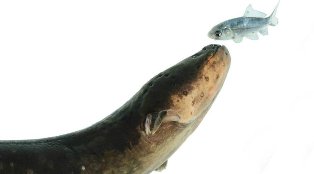
MEXICO: A new study finds that when dealing with struggling or hard-to-subdue prey, these eels bend their bodies into a horseshoe-like shape to more than double the voltage they deliver to their almost-meal.
Electric eels can wield their zapping power in subtle and surprising ways. Electric eels of this size weight around 20 kilos (or 44 pounds.) Electricity is produced due to cells located in three of the fish’s abdominal organs. It has been reported that when the eels discharges an electric current on its prey the muscles of the prey gets contracted with the increase in the pulse rate and it becomes vulnerable for certain period of time. These animals usually strike their prey with a 600 volt shock – which is five times higher than the power of a wall socket in the United States. For larger prey, such as a large crayfish, the eel first bites the prey, and then curls itself into a circle with the prey between its head and tail, he said. However, with larger prey or for younger electric eels, something different happens.


Although it may seem as if the eel is supercharging its abilities, it actually just focuses the charges on one part of the prey’s body, which makes the impact seem more powerful, Catania told the science website. The study showed the eels used feedback from their high-voltage volleys to pinpoint the position of prey.
Catania’s experiments found that the electric eel doubles the amount of electric pulses delivered to its prey through the curling maneuver. “The effect is comparable to administering a dose of a paralytic agent like curare”, said Catania.
“Each of these pulses the eel gives off is activating the nervous system of the prey”.
Eels’ ability to emit electric impulses through water has been studied for years, but it has always been something of a mystery exactly how the mechanism works, according to Vanderbilt’s Kenneth Catania, a professor of biological sciences who has been studying electric eels for years.
“We know from basic physics that bringing two electrical poles together concentrates the electric field, and we know from basic muscle physiology that running a muscle too fast for too long causes exhaustion”. Catania is surprised to see that how this sea creature protects their own brain, muscles and nervous system from getting electrocuted. So far, this remains an open question for the scientific community to embark on.