

Customs Today
  • Home
  • Islamabad
  • Karachi
  • Lahore
  • National
  • Transfers and Postings
  • Chambers & Associations
  • Business
No Result
View All Result
Customs Today
  • Home
  • Islamabad
  • Karachi
  • Lahore
  • National
  • Transfers and Postings
  • Chambers & Associations
  • Business
No Result
View All Result
Customs Today
No Result
View All Result
Home Science & Technology Science

Engineers now understand how complex carbon nanostructures form

byCustoms Today Report
13/04/2015
in Science, Science & Technology
Share on FacebookShare on Twitter

You might also like

Tesla driverless system to use updated radar technology

12/09/2016

Apple to develop its own self-driving technology

10/09/2016

WASHINGTON: Matt Maschmann, a researcher at the University of Missouri (MU), has developed a method to predict the way in which carbon nanotubes (CNTs) are formed. Maschmann is an assistant professor of mechanical and aerospace engineering in MU’s College of Engineering.
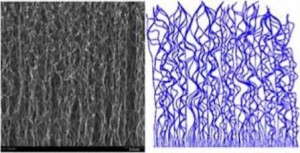
CNTs are microscopic tubular structures. They are “grown” in high-temperature furnaces, using a unique process. These CNT structures are known as “forests”, and the forces involved in creation of CNT structures are quite unpredictable.
In this study, a method was developed for predicting the manner in which the CNTs with complicated structures are formed. CNTs are highly adaptable, and this would enable engineers to add this material into a wide range of products, including combat body armor, aerospace wiring, baseball bats, micro sensors for biomedical applications, and computer logic components.
When CNTs are created in huge numbers they naturally form “forests”. The van der Waals force, which is a nanoscale adhesive force, holds these forests together. These forests are categorized based on their alignment or their rigidity. When CNTs are well aligned and dense, the resulting material has a tendency to be rigid, which would make it useful for mechanical and electrical applications. When the CNTs are disorganized, they are comparatively softer, and possess completely different types of properties.

Related Stories

Tesla driverless system to use updated radar technology

byCT Report
12/09/2016

WASHINGTON: Electric carmaker Tesla announced Sunday it was upgrading its Autopilot software to use more advanced radar technology. In a...

Apple to develop its own self-driving technology

byCT Report
10/09/2016

SAN FRANCISCO: Apple may not become an automaker, but it still wants to develop its own self-driving technology. The iPhone-maker's...

NASA spots slowest known magnetar

byCT Report
10/09/2016

WASHINGTON: Astronomers have found evidence of a magnetar - magnetised neutron star - that spins much slower than the slowest...

‘YouTubers’ outshining old-school television

byCT Report
09/08/2016

SAN FRANCISCO: A media revolution is taking place, and most people over 35 years of age aren’t tuned in. Millennial...

Next Post

Radiation from Fukushima disaster found in Canadian waters

  • Terms and Conditions
  • Disclaimer

© 2011 Customs Today -World's first newspaper on customs. Customs Today.

No Result
View All Result
  • Transfers and Postings
  • Latest News
  • Karachi
  • Islamabad
  • Lahore
  • National
  • Chambers & Associations
  • Business
  • About Us

© 2011 Customs Today -World's first newspaper on customs. Customs Today.