
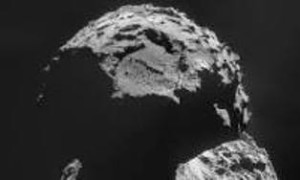


CANADA: Two British astronomers hogged the headlines for a couple of days after their presentation at the National Astronomy Meeting at Venue Cymru in Llandudno, Wales centered around Comet 67P/Churyumov–Gerasimenko – the comet on which European Space Agency’s Philae probe landed last year. The duo claimed that micro-organisms may be involved in giving the comet its properties.
Dr Max Wallis of the University of Cardiff and Professor Chandra Wickramasinghe, Director of the Buckingham Centre for Astrobiology, pointed out the black crust of the comet along with possible large, smooth ‘seas’, flat-bottomed craters and a surface peppered with mega-boulders and suggested that these features are all consistent with a mixture of ice and organic material that consolidate under the sun’s warming during the comet’s orbiting in space, when active micro-organisms can be supported.
They then went onto explain that based on their model, micro-organisms could inhabit cracks in its ice and ‘snow’. Further, organisms containing anti-freeze salts are particularly good at adapting to these conditions and some could be active at temperatures as low as -40 degrees Celsius. Dr Wallis said: “Rosetta has already shown that the comet is not to be seen as a deep-frozen inactive body, but supports geological processes and could be more hospitable to micro-life than our Arctic and Antarctic regions”.
We would like to point out that 67P has been under observation for a long time now and during the months of observation, ESA hasn’t found a single clue about the possibility of life in any form on the comet.

Karachi Port sets 138-year cargo handling record
KARACHI: Pakistan's maritime sector has achieved a major milestone as Karachi Port set a new record in its 138-year history...


