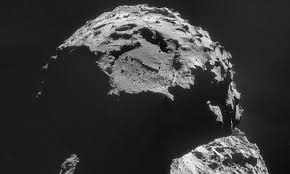
ROME: European Space Agency’s comet lander Philae (pictured) beamed back to Earth some data that made scientists hold their breaths for a few seconds.
The imagery and soil tests showed that Comet 67P/Churyumov-Gerasimenko has on its surface faint traces of sugars and amino acids that are the building blocks of life throughout our planet.
You might also like


ESA scientists currently speculate that the findings may suggests the remote Universe may also host conditions that are hospitable for life. Scientists performed no less than seven studies on what Philae found before drawing their final conclusions.
A paper on the findings was published Thursday in the journal Science. The data used in the studies were gathered during the first 60 hours since the piano-sized probe first landed on the icy comet’s crust in mid-November last year.
Professor Jean-Pierre Bibring, main investigator of the Philae mission, explained that what scientists learned about the properties and physical features of a comet with help from Philae are nothing like they had imagined.
Though ESA mission investigators expected to find a thick icy crust, they found organic molecules on the surface that may be traces of optimal conditions needed to harbor life. Past studies speculate that the same molecules were the seeds of life on our planet.