
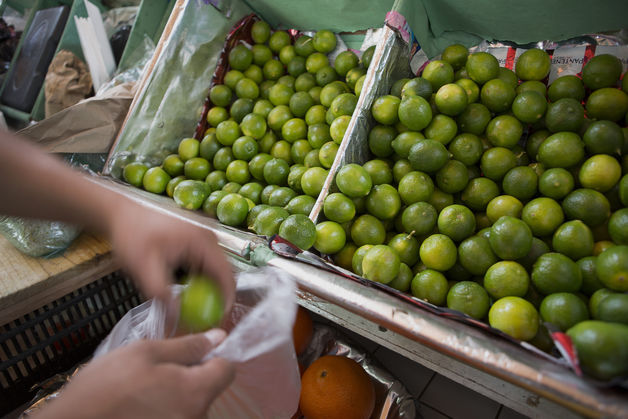
The major lime countries are Brazil and Mexico. Both countries have a good harvest, which means supplies of the fruit are higher. The Mexican exporters are dissatisfied, because the Brazilian season lasts longer. “Normally, Brazil is off the European market at this time of year, but not this year,” a Mexican exporter says. “That has negative consequences for the prices.”
The Brazilians point to Mexico: “Mexico normally has smaller volumes at this time of year, but this year more volume is available.”


The difference between the countries is simple: Mexican ones are greener, Brazilian limes are juicier, a French importer knows. A Dutch importer explains that due to the weather conditions, the Brazilian limes don’t have the characteristic deep green colour. The prices for limes are at a similar level, normally there’s a euro between them. In addition, due to the higher import tariffs of Brazilian limes in Europe, the difference in cost price between Mexico and Brazil has decreased.
Organic limes
While the conventional limes are available in large volumes, growers of its organic cousin are having problems. Most of the organic limes are grown in Mexico and the Dominican Republic. On the Caribbean island, the rain season in April and May was delayed, and it was too hot for too long. Due to these weather conditions, the harvest was disappointing. And thanks to the high domestic demand, there’s little interest in export. In Mexico, the organic lime production is plagued by a fungus that infects trees, thus decimating the harvest.
Harvest Peru -40%
In the San Lorenza Valley in Peru, the most important limes production region in the country, the harvest turns out 40 percent lower this year. According to the growers, climate change is to blame. The price for a 45 kilo bale is between 45 and 60 soles (12.74-16.99 euros). In previous years, the price was around 100 soles (28.32 euros). The growers in the valley expect the prices to increase in August.
Rivals in the field
Other countries in Latin America are working hard on increasing their market share. Colombia, Honduras, El Salvador and Guatemala are trying to improve their position in the lime market. Across the ocean, in Australia, limes make up a small part of the citrus cultivation. The green fruit accounts for 2 percent of the production, even though harvesting can take place 8 months a year. In the north of Queensland, the production is expanding, but there are no exact figures about the larger acreage yet. Export is limited due to trade restrictions by the importing countries. While other citrus can be exported, importing countries doubt whether limes can meet the phytosanitary requirements. The biggest fear is the presence of a fruit fly. Therefore, the Australian citrus association is making efforts to prove that the limes haven’t been infected by fruit flies, and meet the demands. In addition, oranges and mandarins can be protected from the fruit fly through a cold treatment. This treatment isn’t possible for limes, because the fruit is more vulnerable. Finally, high wage costs also pose a challenge for the country’s competitive position.
Egypt better prices
The peak of the Egyptian citrus season is in the winter months. Between December and March, the fruit is shipped. Tohami Trading specializes in the lime trade, with around 70 percent of sales comprising limes. The exporter looks back with satisfaction on the past season, with an export of 160-170 tonnes of limes. He also sees plenty of possibilities to expand the acreage. Important export destinations are Russia, Eastern Europe and the Gulf States. The export benefits from the geographic location relative to Europe, which means export to continent takes only a few days to arrive. The prices remain a point of attention, the exporter says. The pressure is high, but so far, he says, he’s getting better prices for the citrus than competitors from Italy and Spain.
Europe: prices down due to large supplies
The large supplies of limes in Europe put prices under pressure, but with the summer months, during which the most limes are consumed, importers expect the prices to go up again. Earlier this year, the situation was different. The market is following the “classical pattern”, as one Dutch importer describes it. The prices for Brazilian limes increased, and Mexico waited for the prices to come up to the desired level before starting the export. Around the end of May, prices were at 12 euros, three weeks later the market fell. The largest volume is shipped to the European continent, limes are only flown when the client requests it, or if the prices allow it.
According to importers from Germany and France, the market, looking at the prices, is very bad. Depending on the size of the fruit, prices in France are between 4 and 5 euros for a box (4-4.5 kg). Most of the supplies come from Latin America, but if Brazil switches production regions in the middle of summer, there is an opportunity for Israeli exporters. The German exporter is also expecting the prices to go up in the coming weeks. One German importer of organic limes says there is a shortage, which is a damper on the mood. In the Netherlands, prices are at a similar level. After a dip of 4.50 euros per box, with a lower limit of 3.50 to 4 euros for superfluous amounts, the price recovered to the current level of 5 euros. Supplies are decreasing, so prices are expected to go up in the coming weeks. The tropical temperatures further boost demand.
On the British market, traders are also reckoning with increasing prices, driven by summer temperatures and the start of the school holidays. The prices are around 3.75 to 4.50 pounds (5.28-6.33 euros). Delays at the port could have consequences, but according to one British exporter, the effect of that won’t be that bad.
Verdello started on Sicily
On Sicily, the harvest of the Verdello has begun. The volumes aren’t abundant, growers are expecting a reasonable season. The Verdello is mainly destined for the domestic market, as an alternative to the lemon. The price is between 90 cents and one euro, last year the prices were around 1.40 euros at the beginning of the season. According to the producer organization, the fruit is less juicy, but it has a more tart flavour.
North American market stable
Florida used to be an important production area in the United States for limes, but the production was hit hard by citrus greening. Because of that, the domestic cultivation is now a lot smaller, and the largest share is imported from Mexico. Sunkist announced it would offer organic limes, grown in California, for the first time this year. Although the limes are available, the peak in supplies is in late autumn and the winter months. The American market this year is comparable to previous years. The curves in supply and price resemble other years.



