FRANKFURT: European stocks slipped Monday despite a rebound in Asian markets, as a holiday in the U.S. kept trading volumes suppressed.
The Stoxx Europe 600 closed down 0.7%, falling for the first time in five sessions as auto and bank shares declined.
Italian banks were hit hardest, grappling with economic uncertainty and the prospect of lower interest rates as they stand on more than $400 billion in combined bad debts.
Shares in Banca Monte dei Paschi di Siena SpA fell 14% on Monday after the lender said the European Central Bank asked it to cut its bad loans portfolio.
Markets in Asia closed higher, however, while U.S. futures inched upward for much of the day, as the prospect of loose monetary policy continued to help stocks outside Europe recover from a Brexit-induced selloff.
Following the U.K. referendum, “there’s quite a lot going on, and trying to come to a precise assessment is tricky,” said Martin Todd, portfolio manager at Hermes Investment Management.
“The one thing you can say with certainty is rates will be lower for longer yet again,” he added.
Wall Street on Friday posted its biggest weekly gain of the year, returning the S&P 500 to within 1.3% of its all-time high.
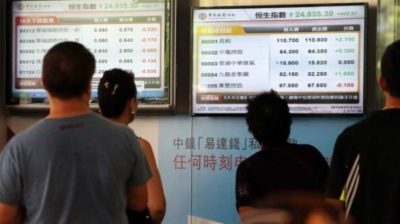
Pedestrians are pictured walking by an electronic stock board of a securities firm in Tokyo on Monday. Stocks in Asia closed higher, catching up with Wall Street’s biggest weekly gain of the year. Japan’s Nikkei Stock Average added 0.6% as the yen weakened against the dollar. ENLARGE
Pedestrians are pictured walking by an electronic stock board of a securities firm in Tokyo on Monday. Stocks in Asia closed higher, catching up with Wall Street’s biggest weekly gain of the year. Japan’s Nikkei Stock Average added 0.6% as the yen weakened against the dollar. PHOTO: ASSOCIATED PRESS
The Bank of England had signaled last week it was likely to loosen policy further this summer, while investors were also ramping up bets that the Bank of Japan would expand its monetary-easing program and the Federal Reserve would hold off on raising interest rates.
In commodities, gold and silver prices climbed to two-year highs on Monday as interest rate expectations fell, boosting shares of mining companies in Europe and Asia.
Meanwhile, some investors continued to question the long-term impact of Britain’s vote to exit the European Union, with banks continuing to slash growth forecasts for the U.K. and Europe.
“It’s a defining moment for Europe, and you never know what will be next,” said Patrick George, head of global markets, EMEA at HSBC.
Still, investors globally are starting to decouple the European economy from the U.K. economy, he said, and compared with previous events, the system is in better shape to absorb this kind of shock—there is more liquidity in the financial system, banks are less leveraged and there is less leverage in financial capital markets.
In currencies, the British pound inched up 0.1% against the dollar on Monday to $1.3290, even after data showed U.K. construction activity fell to its weakest overall performance in seven years.
U.K. Treasury chief George Osborne said in an interview with the Financial Times published Sunday that he plans to cut the corporate tax rate to 15% or less in an effort to lure business investment.
The euro was flat against the dollar at $1.1146, while the dollar was steady against the yen at ¥102.4970.
Earlier, a weaker yen had helped Japan’s Nikkei Stock Average rise 0.6% on Monday in its sixth consecutive day of gains, while stocks in Shanghai added 1.9% and Hong Kong’s Hang Seng Index added 1.3%.
Australian shares rose 0.7%, even after Saturday’s federal election failed to provide a decisive win for any party.
The focus for investors now turns to the monthly U.S. jobs report, due later this week, which will show whether May’s unexpectedly poor showing was an anomaly or a sign of a broader hiring slowdown in the world’s largest economy.