

Customs Today
  • Home
  • Islamabad
  • Karachi
  • Lahore
  • National
  • Transfers and Postings
  • Chambers & Associations
  • Business
No Result
View All Result
Customs Today
  • Home
  • Islamabad
  • Karachi
  • Lahore
  • National
  • Transfers and Postings
  • Chambers & Associations
  • Business
No Result
View All Result
Customs Today
No Result
View All Result
Home Science & Technology Science

Everest glaciers may retreat 70% by end of century, warns new study

byCustoms Today Report
28/05/2015
in Science, Science & Technology
Share on FacebookShare on Twitter

You might also like

Tesla driverless system to use updated radar technology

12/09/2016

Apple to develop its own self-driving technology

10/09/2016

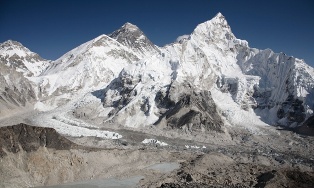
MEXICO: Glaciers in the Everest region could disappear this century if greenhouse gas emissions continue to rise, a new scientific study says, signalling an ecological shift that could set off massive disasters in the Kosi river basin and devastating floods downstream in India.
The paper, published on Wednesday in the journal The Cryosphere by researchers from Nepal, France and the Netherlands, says Everest glaciers could be very sensitive to future warming and sustained ice loss of 70-99% is possible by 2100.
“Continued and possibly accelerated mass loss from glaciers is likely given the projected increase in temperatures,” said Joseph Shea, a glacier hydrologist with Kathmandu-based International Centre for Integrated Mountain Development (ICIMOD) and the leader of the project.
Glaciers in the high mountain regions of Asia, which include the Himalayas, contain the largest volume of ice outside the polar regions.
The scientists say lakes could be formed from glacier debris and if they burst due to avalanches and earthquakes, it could lead to tragedy in the Kosi basin.
Though the signal of future glacier change in the region is “clear and compelling”, the researchers say the estimates should be treated with caution.
“Our estimates need to be taken very cautiously, as considerable uncertainties remain,” said Patrick Wagnon, a glaciologist with Institut de recherche pour le développement in France.
The Dudh Kosi basin in the Nepal Himalayas, where the study was conducted, is home to some of the world’s highest mountain peaks, including the 8,848-metre high Mt Everest, and to over 400 square kilometres of glacier area.

Tags: Everest glaciersPatrick Wagnon

Related Stories

Tesla driverless system to use updated radar technology

byCT Report
12/09/2016

WASHINGTON: Electric carmaker Tesla announced Sunday it was upgrading its Autopilot software to use more advanced radar technology. In a...

Apple to develop its own self-driving technology

byCT Report
10/09/2016

SAN FRANCISCO: Apple may not become an automaker, but it still wants to develop its own self-driving technology. The iPhone-maker's...

NASA spots slowest known magnetar

byCT Report
10/09/2016

WASHINGTON: Astronomers have found evidence of a magnetar - magnetised neutron star - that spins much slower than the slowest...

‘YouTubers’ outshining old-school television

byCT Report
09/08/2016

SAN FRANCISCO: A media revolution is taking place, and most people over 35 years of age aren’t tuned in. Millennial...

Next Post

Hong Kong stocks trade lower at start,  Hang Seng drops 0.9%

  • Terms and Conditions
  • Disclaimer

© 2011 Customs Today -World's first newspaper on customs. Customs Today.

No Result
View All Result
  • Transfers and Postings
  • Latest News
  • Karachi
  • Islamabad
  • Lahore
  • National
  • Chambers & Associations
  • Business
  • About Us

© 2011 Customs Today -World's first newspaper on customs. Customs Today.