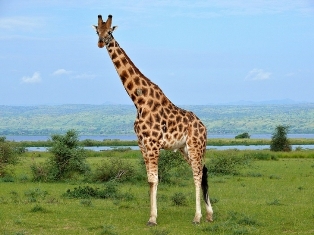


FRANCE: The giraffe is the world’s tallest mammal. For years, the origin of its long, slender neck baffled the scientific community. Scientists worked around the theory that the evolution enabled the mammals to find food in higher places. Their long necks are also believed to help them fight predators better.
A new study of its fossil cervical vertebrae proved that the evolution of the giraffe’s long neck happened in several stages. First, the neck vertebrae extended towards the mammal’s head. Millions of years later, its vertebrae extended towards the tail. For the first time, the scientific community is given facts on the transformation of the giraffe’s extinct ancestors.
“It’s interesting to note that that the lengthening was not consistent,” said giraffe anatomy expert Nikos Solounias who led the research. Nikos is also a paleontologist at the College of Osteopathic Medicine in New York Institute of Technology (NYIT).
Solounias explained how the giraffe’s elongated neck came to be. The third vertebra from the top of a mammal’s spine is called C3 vertebra. The front part of the giraffe’s C3 vertebra began to elongate in one cluster of the mammal’s species. Millions of years later, the back part of the C3 vertebra started to extend. Fast forward to today, the modern giraffe is the only giraffe species whose C3 vertebra elongated in both front and back. This evolutionary alteration explains the occurrence of its slender and unusually long neck.
Together with medical student Melinda Danowitz from NYIT’s Academic Medicine Scholars Program, Solounias looked into 71 fossilized giraffe vertebrae. The collection covered two living and nine extinct species. The bones date back to the late 1800s and early 1900s and were lent by museums in Greece, Germany, Kenya, Sweden, Austria and England.

Karachi Port sets 138-year cargo handling record
KARACHI: Pakistan's maritime sector has achieved a major milestone as Karachi Port set a new record in its 138-year history...