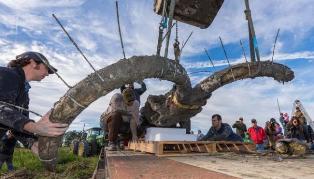


MEXICO: James Bristle and a friend were digging in his soybean field when they unearthed what looked like a bent fence post, caked with mud. Instead, it was part of a pelvis from an ancient woolly mammoth that lived up to 15,000 years ago.
Study of the bones may shed light on when humans arrived in the Americas, a topic of debate among archaeologists.
On Wednesday, University of Michigan professor Daniel Fisher — who had been contacted via the university by Bristle and his friends — was able to go out and confirm the find.
A team of paleontologists from the University of Michigan and an excavator recovered about 20 per cent of the animal’s skeleton this week in Michigan. Aside from the pelvis, they found the skull and two tusks, along with numerous vertebrae, ribs and both shoulder blades.
“We think that humans were here and may have butchered and stashed the meat so that they could come back later for it,” Fisher said Friday.
Three boulders the size of basketballs found next to the remains may have been used to anchor the carcass in a pond, he said.
“We get calls once or twice a year about new specimens like this,” Fisher told The Washington Post. But they’re usually mastodons. It’s a bit more unusual to find a mammoth, the species more closely related to modern elephants.
After establishing that Bristle could only spare one day for the mammoth extraction, Fisher and his team went into overdrive. On Thursday they were deep in the muck, doing their best to carefully document and extract the bones at top speed.
“We don’t just want to pull the bones and tug everything out of the dirt,” Fisher explained. “We want to get the context for how everything was placed at the site.”
Mammoths and mastodons, another elephant-like creature, were common in North America before disappearing around 11,700 years ago.
Remains of about 300 mastodons and 30 mammoths have been discovered in Michigan, Fisher said, although most of the mammoth finds aren’t as complete as the one in Bristle’s field.

Karachi Port sets 138-year cargo handling record
KARACHI: Pakistan's maritime sector has achieved a major milestone as Karachi Port set a new record in its 138-year history...