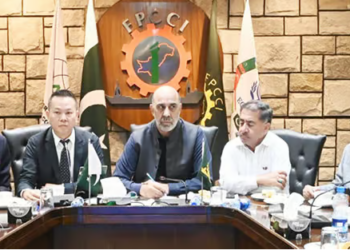
ISLAMABAD: The Federal Board of Revenue (FBR) has placed institutional reform, digital transformation, and automation at the top of its agenda to help build a documented economy, with the ultimate objective of significantly increasing Pakistan’s tax-to-GDP ratio.
Dr Najeeb Ullah, Chief Reforms and Modernization at the FBR, said that reforms and digitization are critical to achieving a documented economy, which in turn is essential for raising the tax-to-GDP ratio and ensuring long-term economic sustainability.


Dr Najeeb, who is also serving as the Acting Chief of the Transformation Delivery Unit, said the unit is responsible for overseeing and implementing the ongoing transformation process within the FBR.
He noted that the institution is currently undergoing a major phase of reform, digital transformation, and automation aimed at modernizing tax administration and addressing Pakistan’s persistent economic challenges.
According to the senior official, digital transformation has become the central pillar of the FBR’s reform agenda. The gradual integration of process automation is fundamentally reshaping tax administration in Pakistan by replacing outdated, manual systems with automated, cloud-based platforms.
These systems enable real-time monitoring, advanced data analytics, and stronger enforcement mechanisms.
He said that these reforms have already started to deliver tangible results.
In December 2025, the FBR recorded its highest-ever monthly revenue collection of Rs1,427 billion, achieving 99 percent of the assigned target, he said.
This performance was attributed to digitization initiatives, promotion of cashless transactions, and enhanced enforcement measures.
As a result, Pakistan’s tax-to-GDP ratio increased to 10.3 percent in FY2025, up from 8.8 percent in the previous year, with further improvements expected as reforms are institutionalized.
The government, under the direct oversight of Prime Minister Shehbaz Sharif through regular review meetings, views these reforms as essential for sustainable revenue growth.
The reforms aim to broaden the tax base, reduce over-reliance on the salaried class and formal sectors, and bring more economic activity into the documented framework.
He said that business facilitation initiatives, including single-window operations and streamlined regulatory processes, are also being introduced to support compliance and economic activity.
Dr Najeeb said that digital transformation will continue to anchor the FBR’s reform agenda in 2026, as the revenue authority modernizes its tax administration and enforcement systems.
He added that the broader transformation roadmap focuses on expanding and deepening the tax base while implementing institutional reforms to ensure sustainable revenue generation.
The FBR has set an ambitious medium-term target of increasing Pakistan’s tax-to-GDP ratio to 18 percent.
This goal is to be achieved through wider tax base coverage, stronger enforcement supported by digital tools, and improved governance mechanisms, he said.
Dr Najeeb said that key reforms include the introduction of performance management systems for FBR staff, separation of divisional functions, and third-party validation of reform initiatives to enhance transparency and efficiency.
He further said that simplification of tax filing procedures is a major focus area. Automated tax return forms for salaried individuals, integrated with central databases, are being actively implemented to encourage voluntary compliance and make the tax system more user-friendly.
With these reforms, the FBR aims to transform itself into a modern, technology-driven institution capable of supporting Pakistan’s economic sustainability and long-term growth.