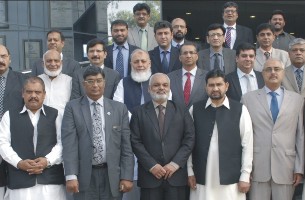
FAISALABAD: President Faisalabad Chamber of Commerce and Industry (FCCI) Chaudhary Muhammad Nawaz government officials should be fully aware of the prevailing economic situation, which will help them to contribute their key role in making realistic and productive economic policies.
Addressing the participants, he said that Pakistan’s economy is on the road to progress as almost all macro-economic indicators are positive. Foreign reserves are in excess of $19.92 billion and balance of payments position looks comfortable whereas oil prices are low and overseas Pakistanis remittances are on the rise.

He also mentioned the economic challenges that should necessarily be met are that our GDP, which is growing at an average rate of 3.8 percent for the last 3-4 years, needs to grow at 7 percent to sustain its future growth. A tax structure that should be equitable, fair, non-anomalous, investment driven with more income tax payers brought into the tax net should be devised besides provision of uninterrupted supply of electricity and gas to the industries at affordable price.
He said that small and medium entrepreneurs (SMEs) are backbone to industrial development. Faisalabad has its origin from SMEs and their problems need to be looked in the better national perspective as value added textiles are not picking up because SMEs are facing energy crisis severely.
There is no contradiction between government and business community because we both want the welfare, progress and prosperity of the people of Pakistan with main focus on neglected and deprived segments of the society, he added.
He further said that water crisis can prove more fatal than the energy crisis. We have per capita water availability at 1000 cubic meters per annum which is estimated to lower down to per capita 850 cubic meters by 2025 owing to rising population and urbanization in the country.
FCCI Chief said that construction of multi-purpose large dams on rivers and small dams on canal heads are vital to produce cheaper hydel electricity besides promoting alternative energy resources particularly solar, coal, solid waste management, wind, biogas, etc.
He said that uninterrupted and affordable energy mix should be designed in a way that cost of electricity should be lowered, affordable and competitive in price with regional countries.
The government should also facilitate the private sector with easy taxation instead of complex system that has been introduced in the Federal Budget 2014-15 and 2015-16, he said, adding that entire tax machinery needs proper rationalization for credible tax system.
Chaudhary Nawaz said that our industrial economy has been worst hit by the shortage of electricity and gas causing decline at rate of 2 percent per annum to GDP.
However, our textile exports which currently are hovering around $13 billion in the national exports, can easily be increased up to US$ 26 billion if uninterrupted supply of electricity and gas is made available to the textile industries, he suggested.
Chaudhary Nawaz said that the developing economies should enhance trade amongst themselves. Today 60 percent trade in the world is among regional blocks. Therefore we should focus on Afro-Asian trade as trends of international trade have got massive changes from the traditional export destinations of USA and Europe due to prolonged recession of their economies.
He said that Pakistan with its geographical location can become regional and intra-regional trade hub for Central Asia and Middle East and even a common market can be developed amongst India, China, Turkey and other countries in the region.
We should diversify our exports of traditional items to non-traditional markets and non-traditional items as agro-food, dairy products to traditional markets, he said, adding that Special
He said that about 45 percent of our youth is in the age of 18-25 years which if harnessed with need-based vocational and technical education, could prove an asset for the country. We should utilize our demographic assets by allocating 80 percent of education budget to technical and vocational education to create a ‘Skill Pakistan’, he suggested.